


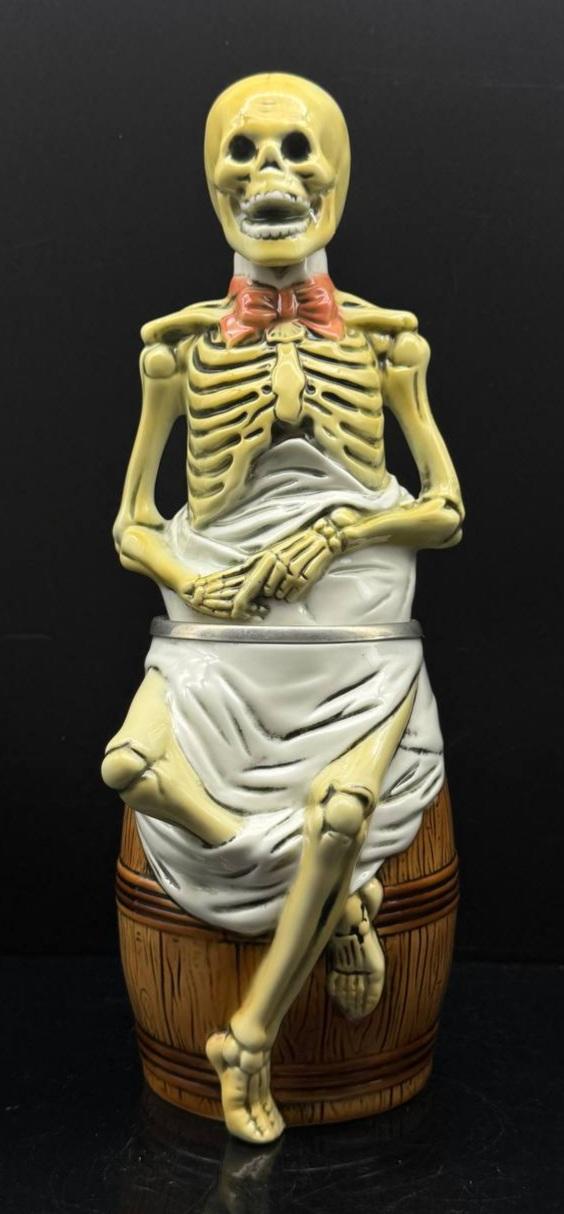
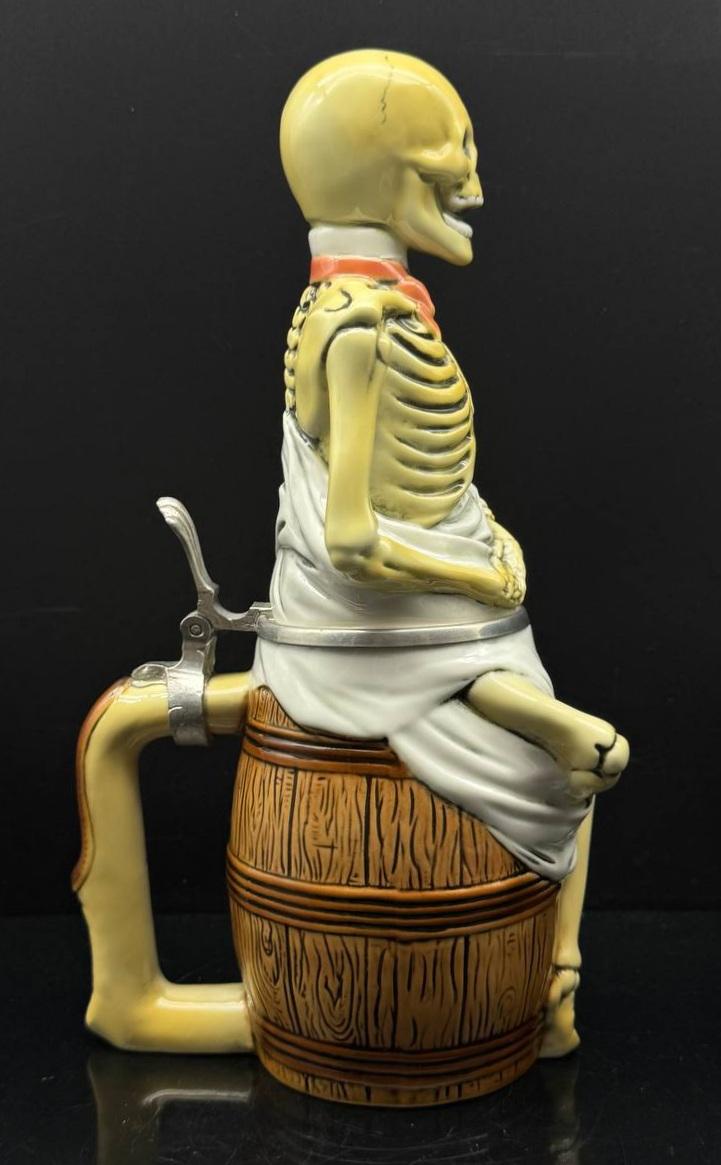
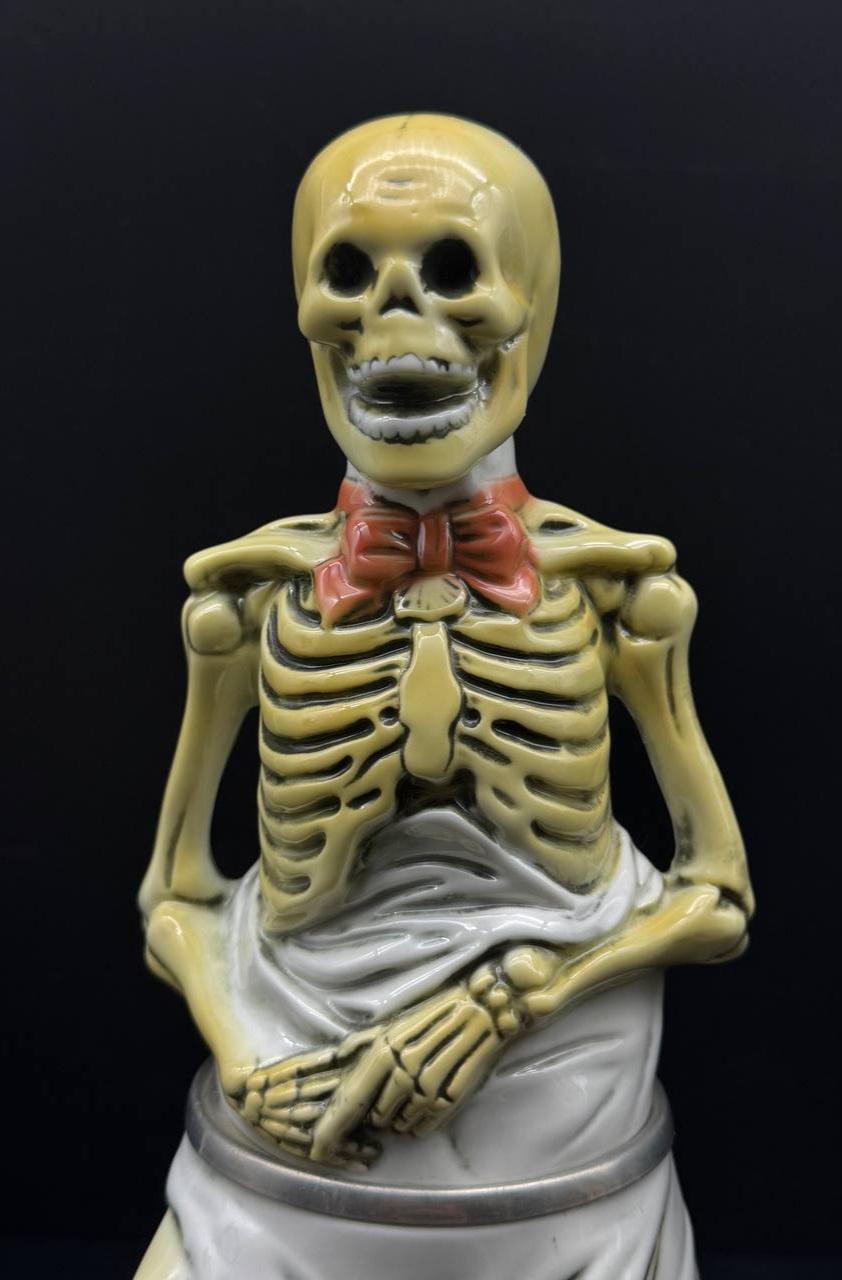
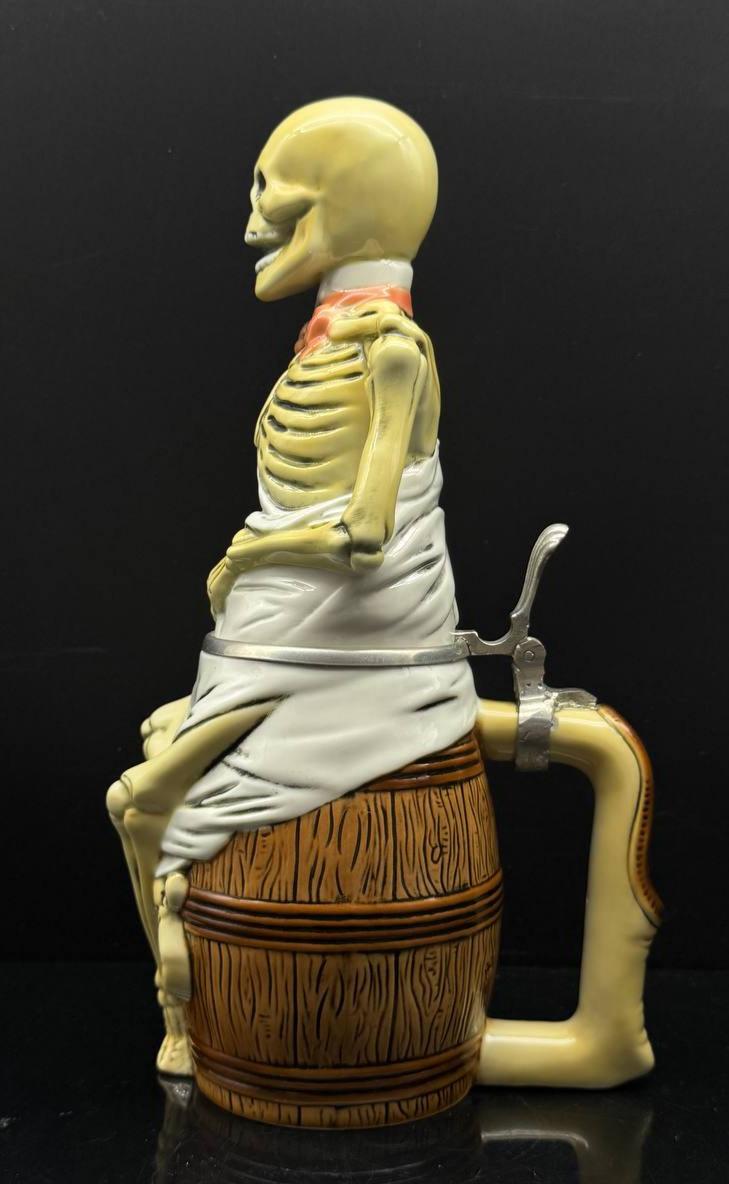
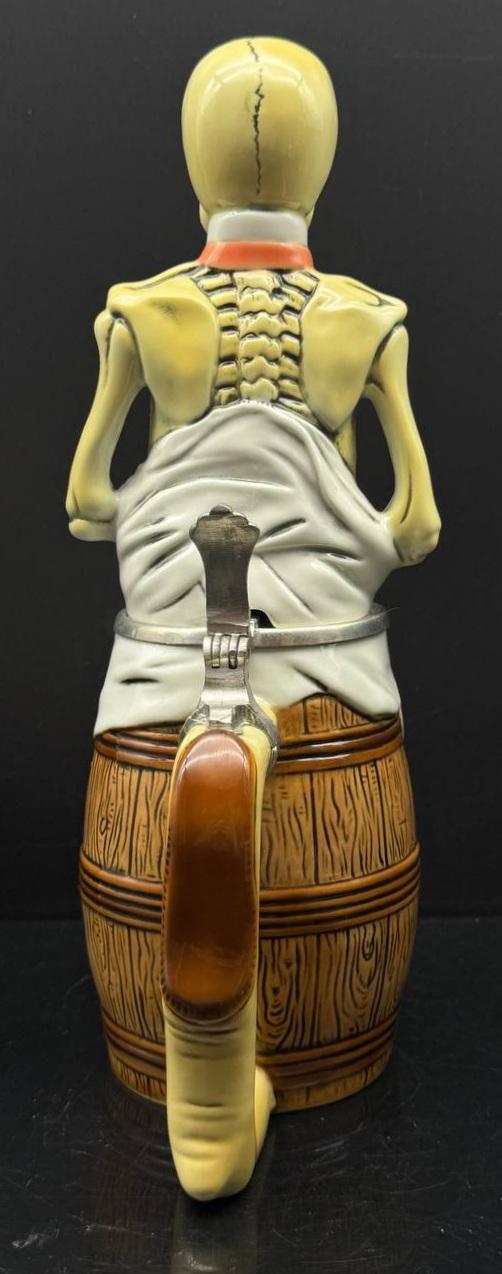
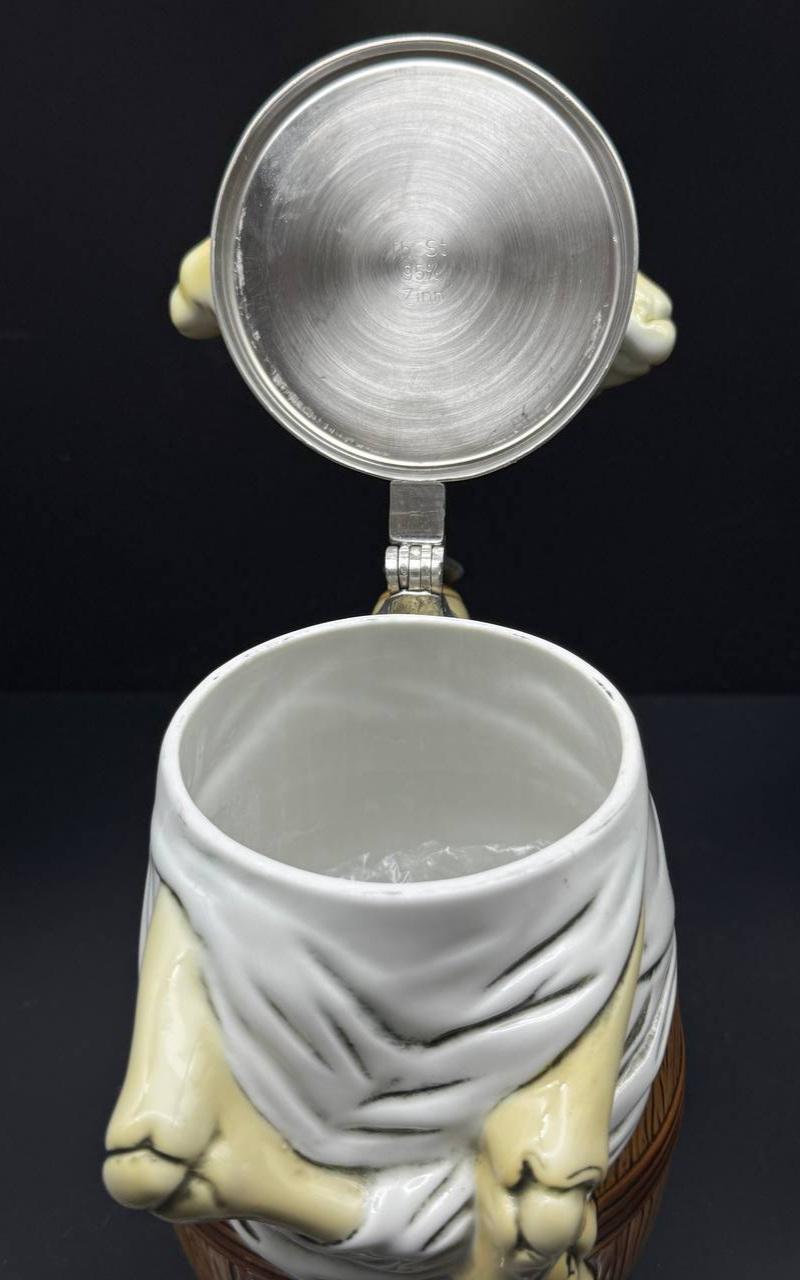
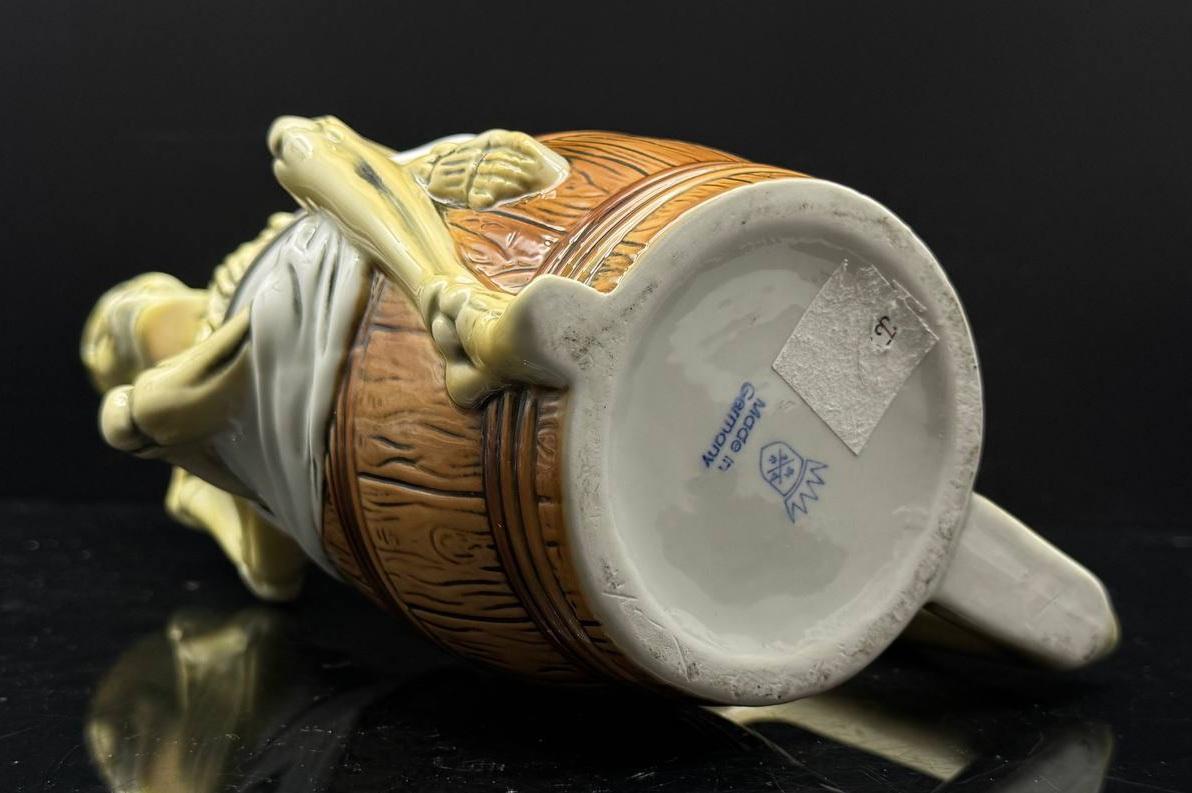
Collectible porcelain beer mug "Waiter skeleton on a barrel". This shaped mug was made in the period 1990-1995 at the German porcelain factory Albert Stahl & Co. In the Albert Stahl & Co. product catalog, the model of this mug has the number 12335. The model was created based on the earlier model number 190, developed by the Ernst Bohne & Söhne factory at the end of the 19th century. In Ernst Bohne & Söhne's version, it was not a mug, but a bottle. The head and neck of a skeleton were used as the stopper in the Ernst Bohne & Söhne bottle. Albert Stahl & Co. also produced bottles of this design. Nevertheless, a mug of this shape is already a modern innovative idea of Albert Stahl & Co.
See the link for the source of information:
[link]
The head and upper torso of the skeleton serve as a hinged lid, which is mounted on a traditional tin rim. The skeleton is depicted in a joking manner ("waiter") — with a red bow tie around his neck and a white cloth wrapped around his waist, imitating an apron.
Ernst Bohne first started porcelain decoration in 1848, only installing a kiln for the manufacture of porcelain in 1850. When Ernst died in 1856, his sons, Gustav, Karl and David took over the company as Ernst Bohne & Söhne. By 1883 David was left as sole proprietor, so in turn David's children continued the dynasty, operating as Ernst Bohne & Söhne Inhaber Bernhard Bohne und Martha Suhr by 1907. The company was purchased by Gebrüder Heubach of Lichte in 1919 and ran as a branch of Heubach until 1930, when the factory capacity was no longer required. After being repurchased in 1937, Ernst Bohne & Söhne was reopened, at the original address, as Albert Stahl & Co. vormals Ernst Bohne & Söhne . Albert Stahl was the one time accountant for Ernst Bohne & Söhne. Following World War II the factory was nationalised by the East German government and subsequently merged with the Sitzendorfer Porzellanmanufaktur in 1974, but then in 1990 was reprivatised and reassumed the name Albert Stahl & Co. At this point they commenced making "reproductions" of the Ernst Bohne & Söhne range, as well as other figural steins.
See the link for the source of information: [link]
The image of a skeletal waiter sitting on a barrel (often with a bottle, mug, or tray in his hands) goes back to the European medieval philosophy of Memento mori ("remember death"), the Latin catchphrase Carpe diem ("seize the moment"), and the ancient drinking traditions of inns. This popular souvenir image (in the form of figurines, ashtrays, damask curtains or decorative elements of bars) symbolizes an ironic attitude towards the transience of life.
The origins and evolution of the image.
1. The medieval story "The Dance of Death" (Danse Macabre).
In the 14th–16th centuries, the Danse Macabre genre originated in Europe against the background of plague epidemics. Death in the form of a skeleton was depicted as taking people of all classes to the grave — from kings to peasants. Skeletons were often depicted grinning, playing musical instruments, or parodying everyday human professions. The image of a skeleton "serving" the living as a waiter or innkeeper grew out of this tradition as a caricature of worldly vanity.
2. The tavern's motto is "Drink while you're alive."
In traditional European culture (especially in Germany, the Czech Republic and Spain), a wine or beer barrel has always been associated with fun, abundance and Bacchus (the god of winemaking). The skeleton planted on a barrel became a vivid illustration of the popular drinking philosophy:
"If you drink, you will die. If you don't drink, you'll die anyway. Well, drink and have fun while you're alive!"
The skeleton waiter on the barrel conveys black irony: he seems to hint to the guests of the institution that they can spend the rest of their short lives in pleasure without taking everyday worries too seriously.
3. The era of Romanticism and pirate aesthetics (19th century).
In modern times, the image of a skeleton hugging a barrel of rum or alcohol has become firmly entrenched in maritime and pirate folklore. Stories about dead sailors guarding barrels of gold or alcohol in the holds of sunken ships popularized this story in adventure literature, and then in popular culture.
4. Mexican Day of the Dead (Día de los Muertos).
An additional impetus to the image was given by Mexican culture, where death is not mourned, but celebrated. Katrinas skeletons and kalak figurines are depicted as ordinary people: musicians, janitors, brides, and, among others, waiters with trays or bartenders at barrels. This cheerful aesthetic migrated from Latin America to the global interior design of bars and restaurants.
Bekijk alles van Paulo Vik Falcon
 Producent info
Bekijk alles van producent Albert Stahl & Co

Commentaren (0)
Log in om een commentaar toe te voegen.