


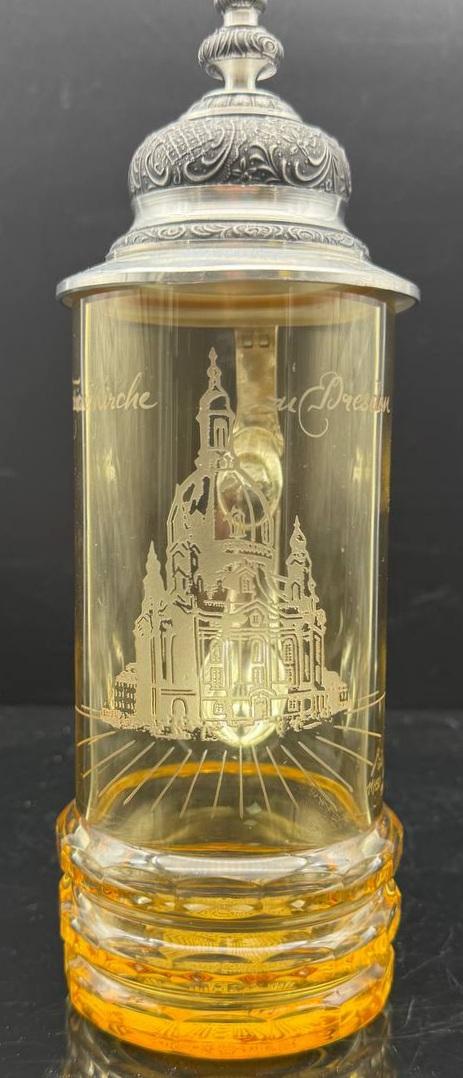
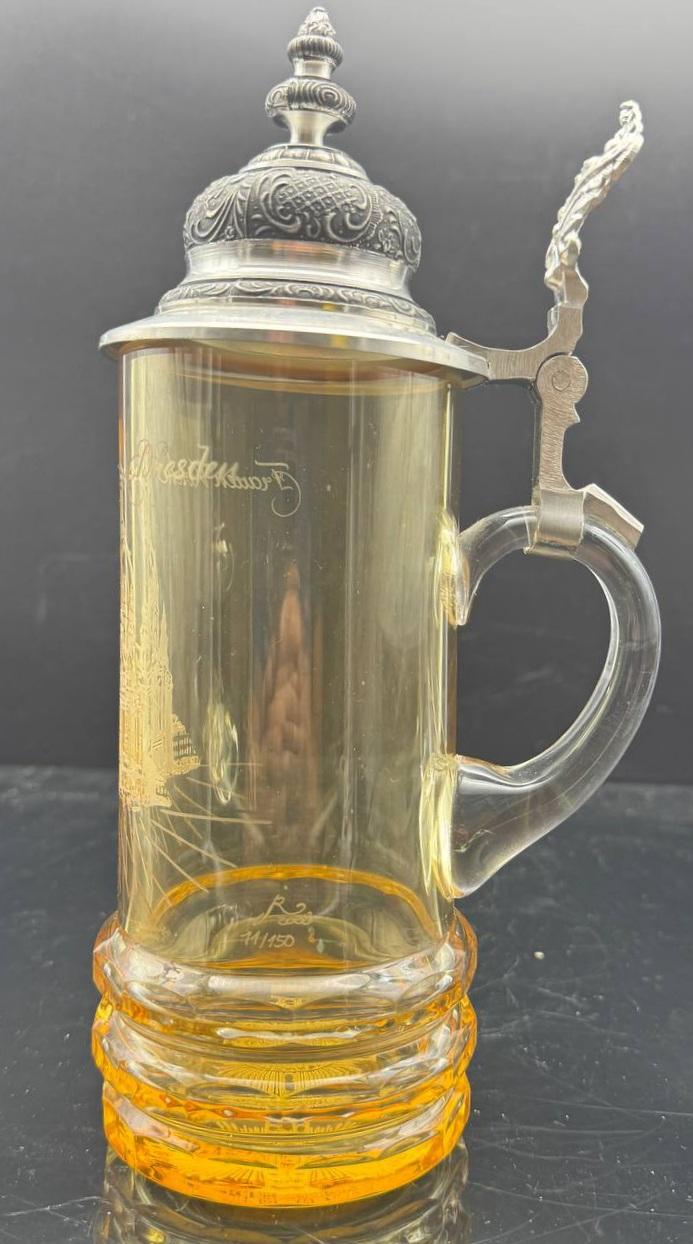
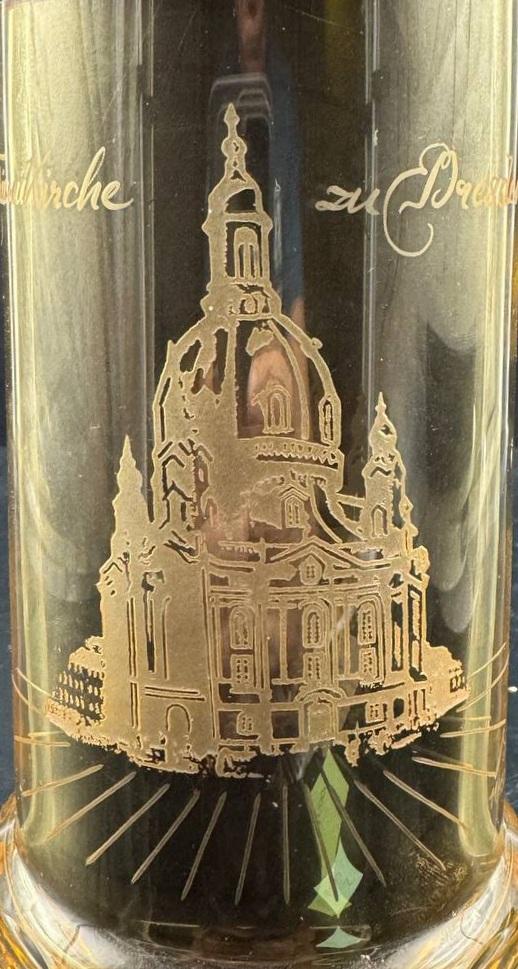
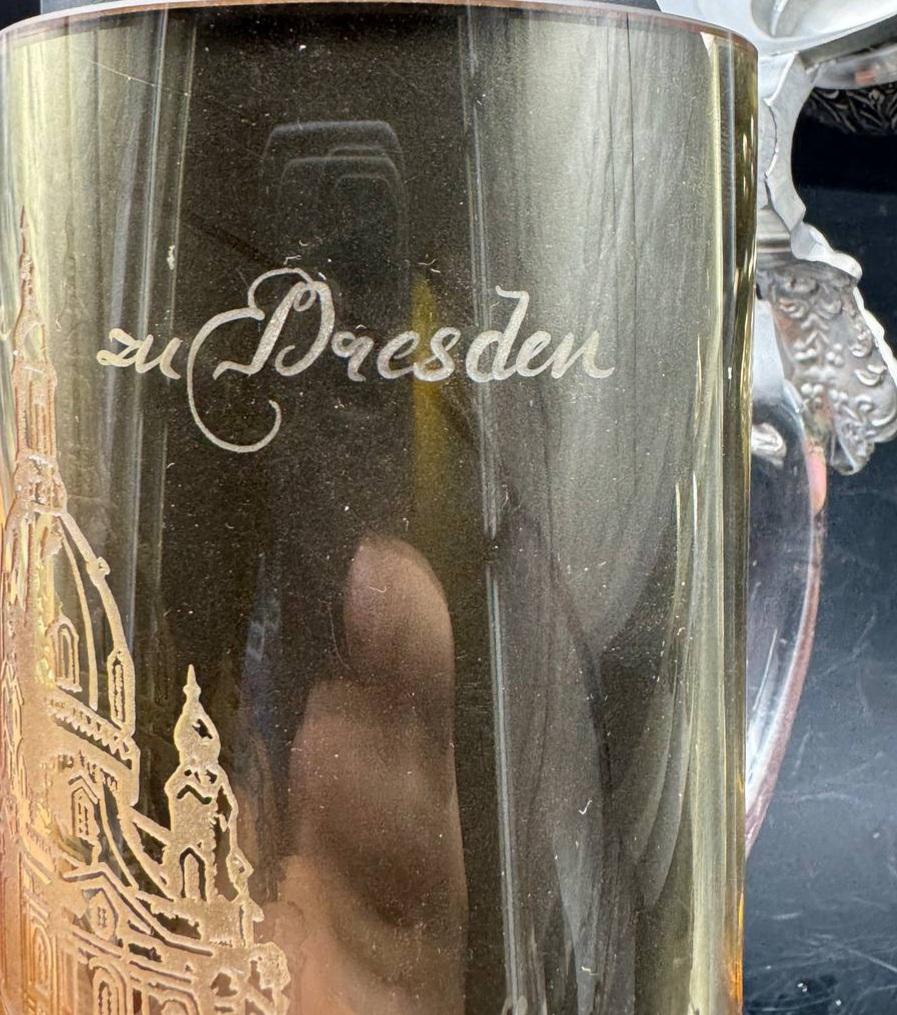
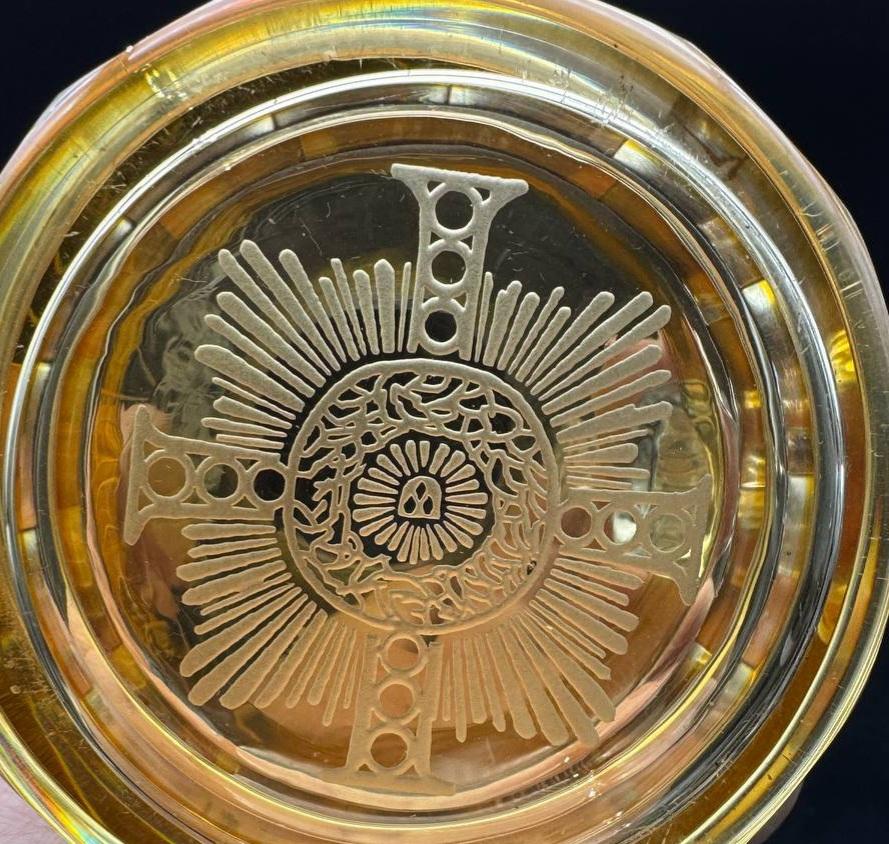
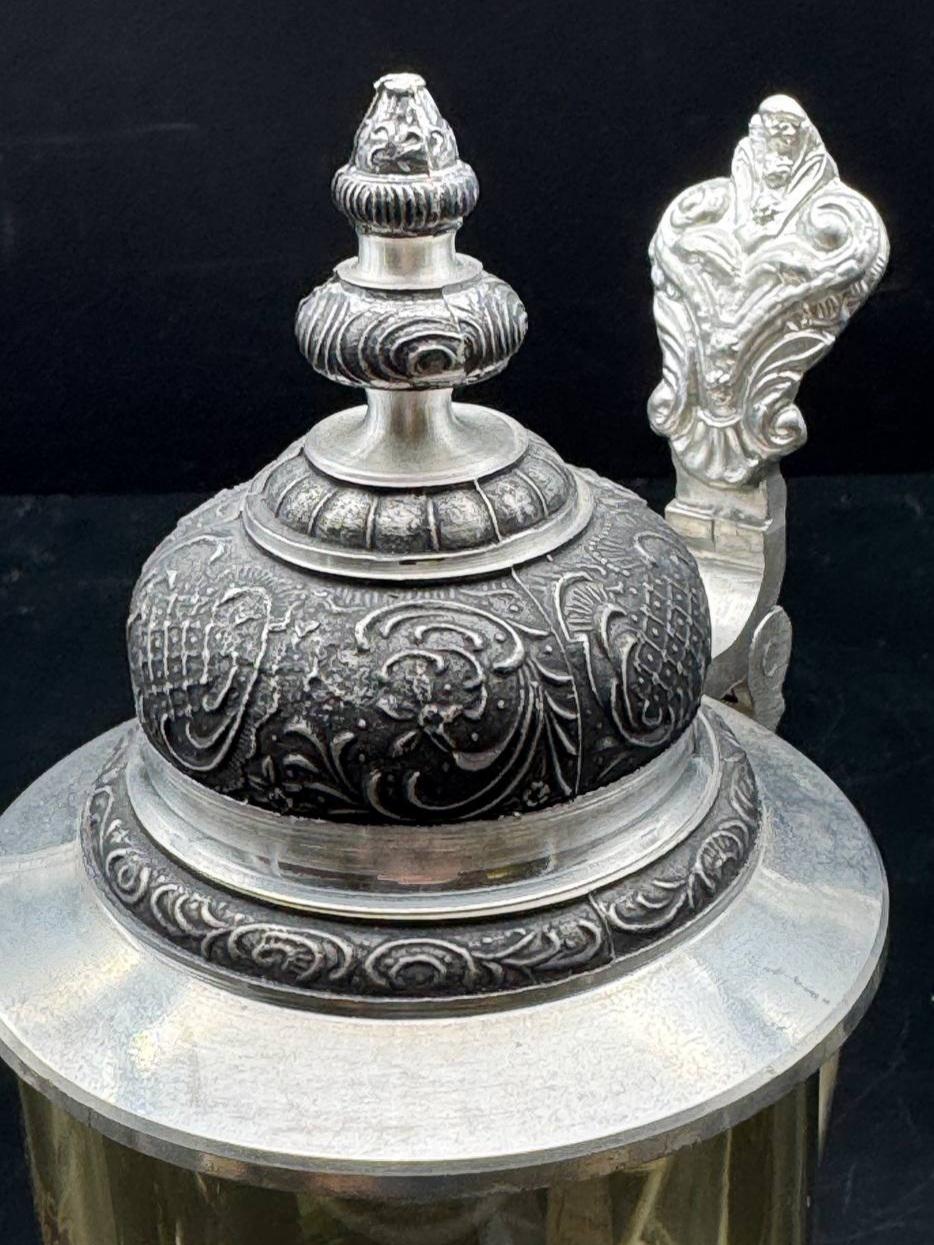
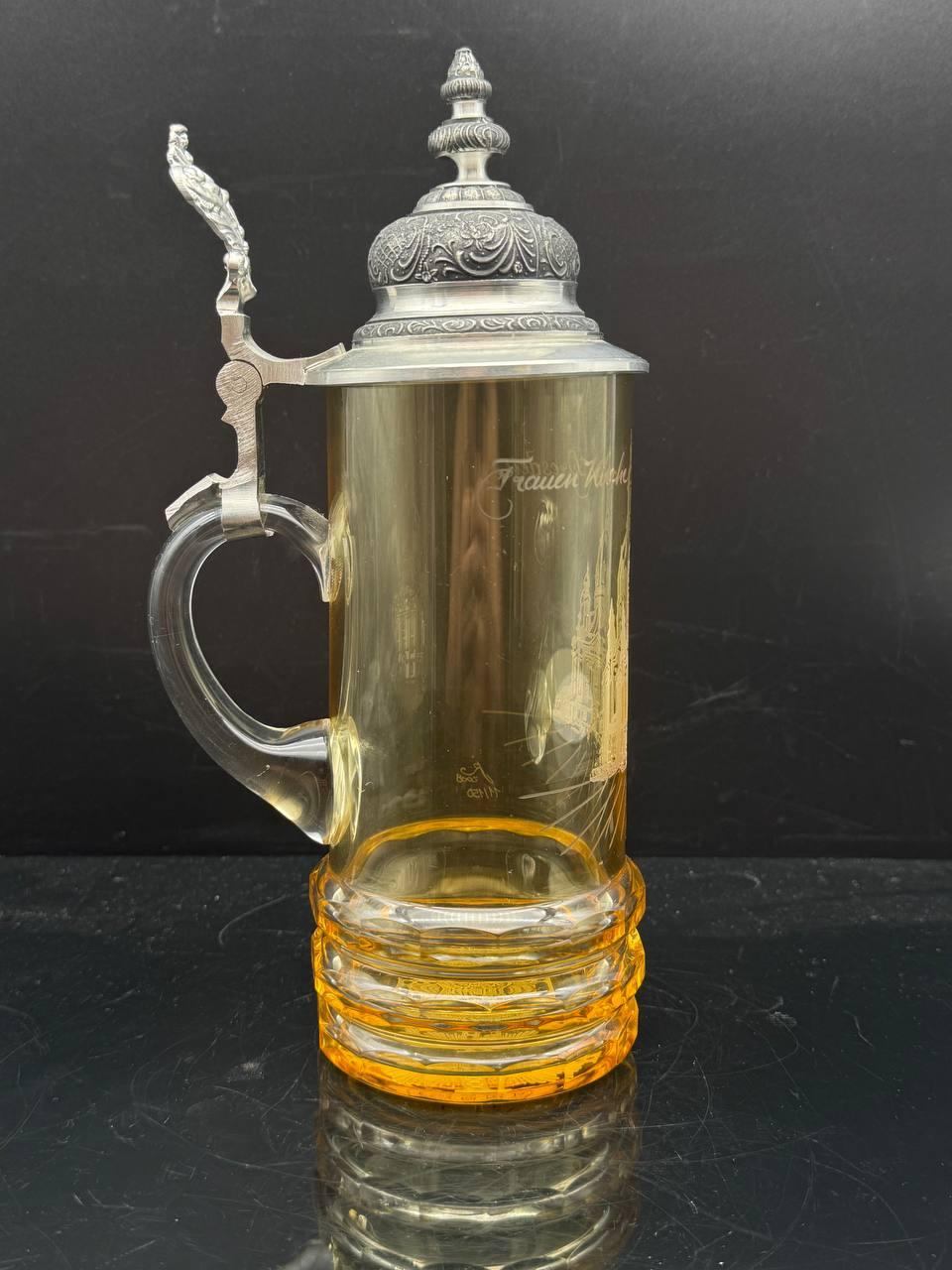
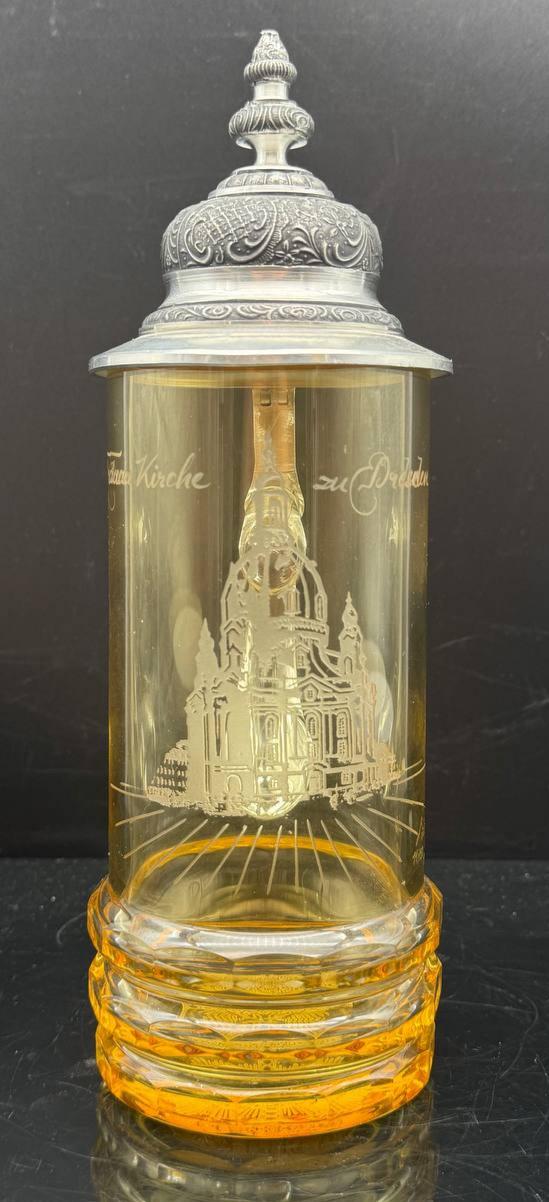
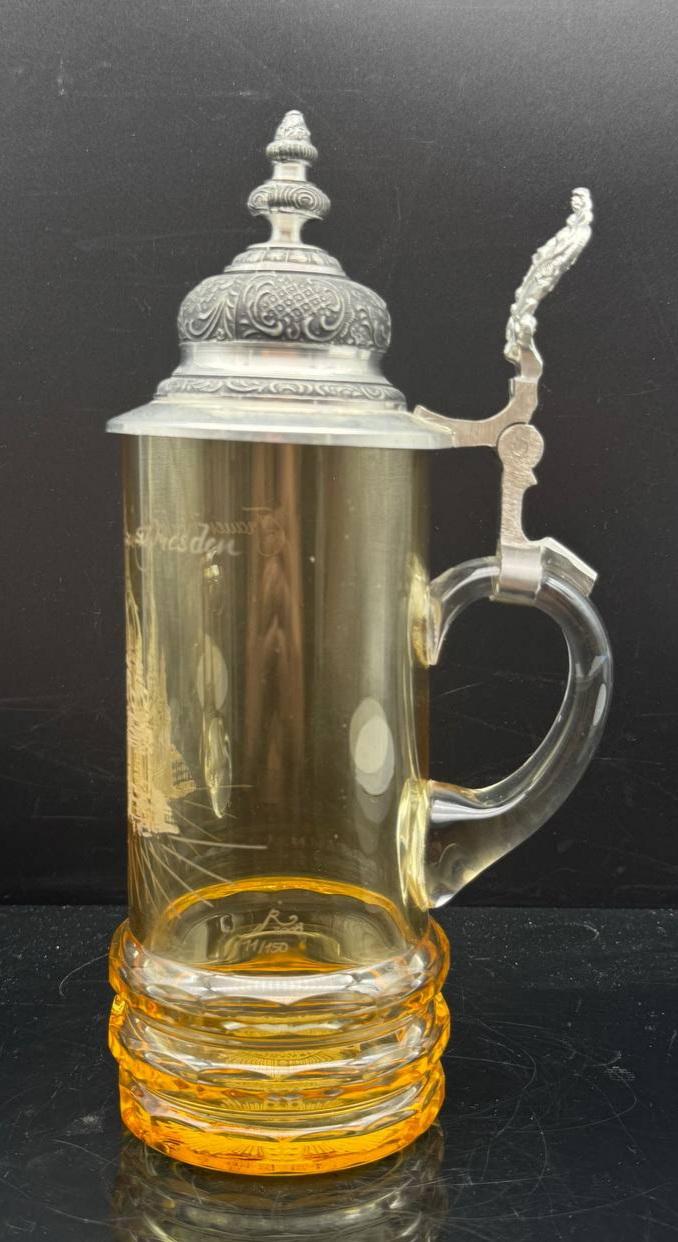
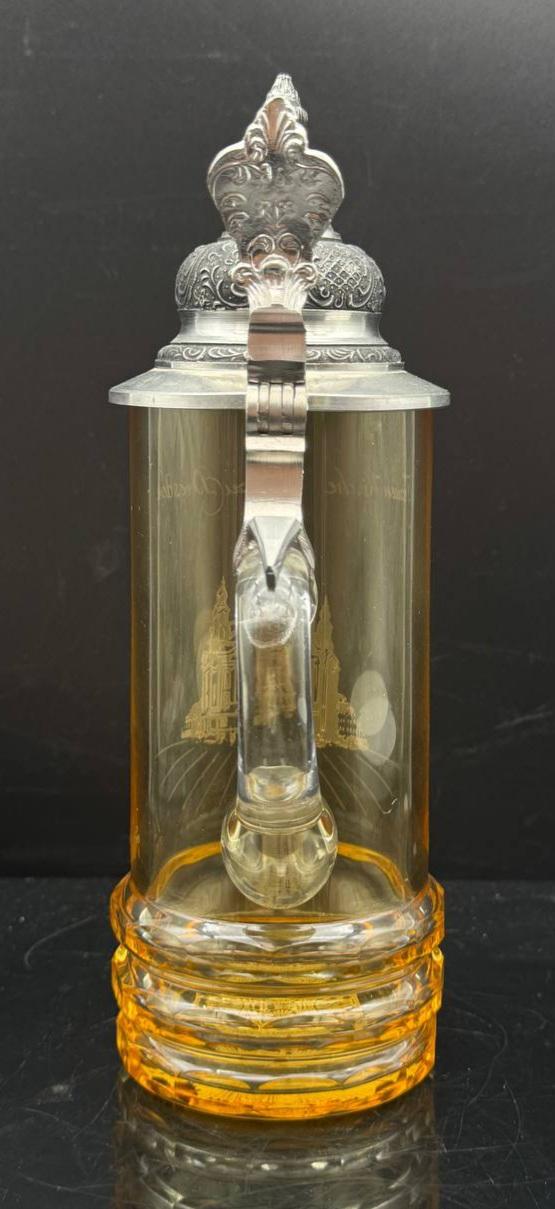
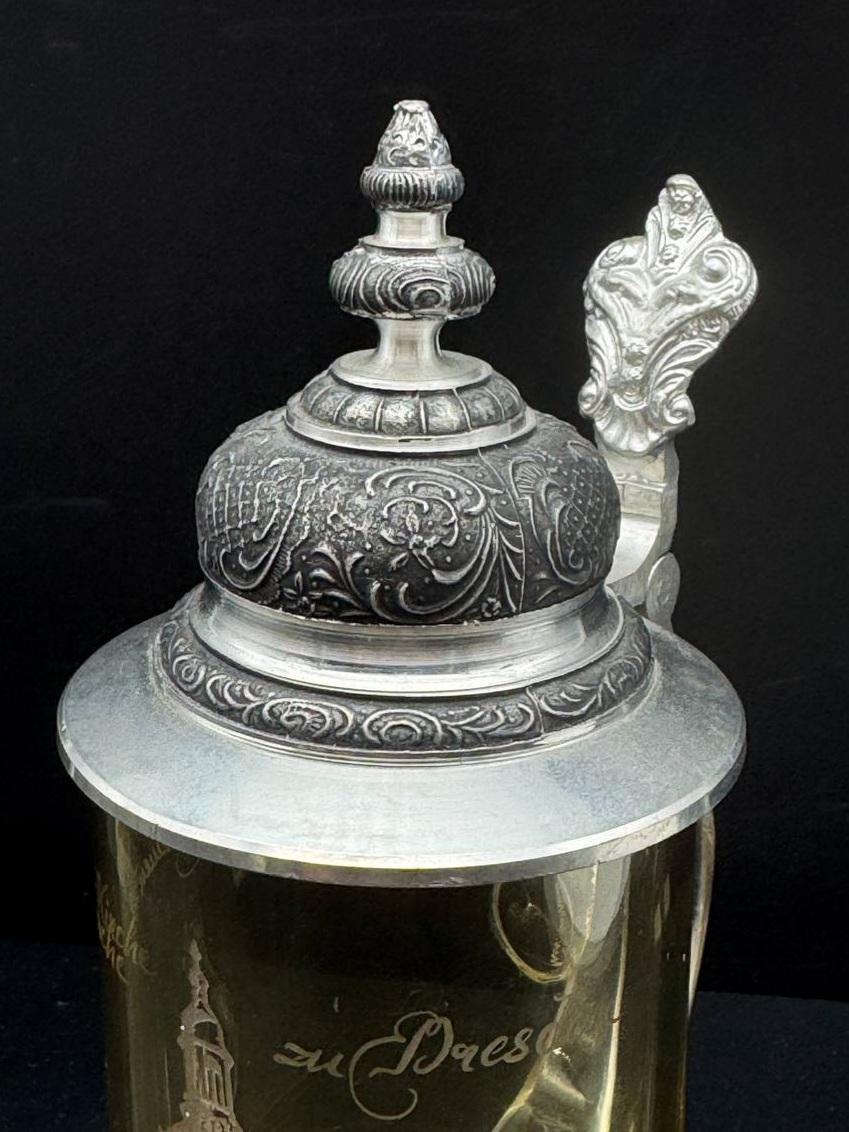
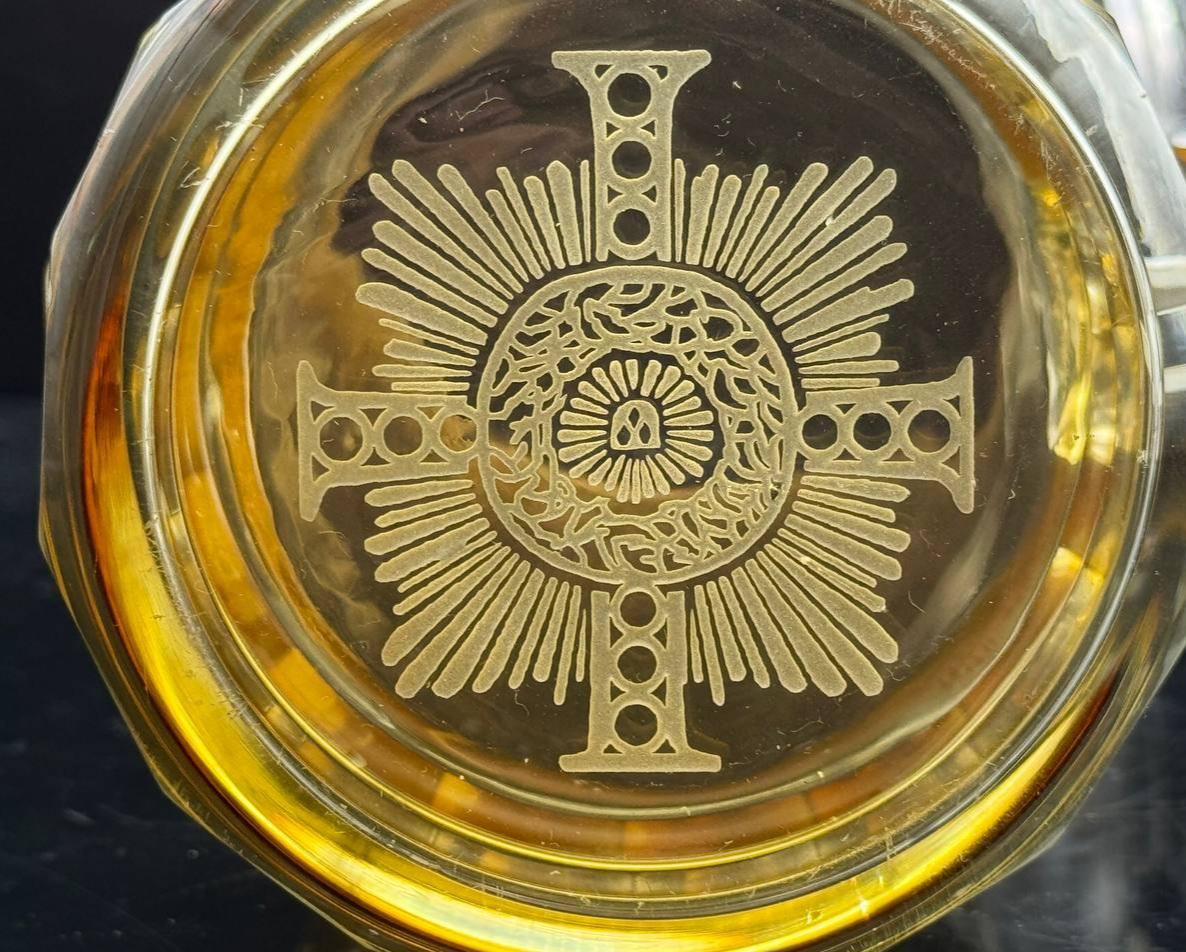
Collection mug "Frauenkirche zu Derezden" (Church of the Virgin in Dresden). The handmade amber glass mug was made at the end of 1999 using the technology of blown glass into a mold. The mug does not have the mark of the glass manufactory where it was made. The reason for this is that the shape of this mug was ordered by a special batch in a small print run, not for sale on the open market. Additional confirmation of this can be found when studying the decorations and inscriptions applied to the mug by hand artistic engraving with a fine diamond abrasive.
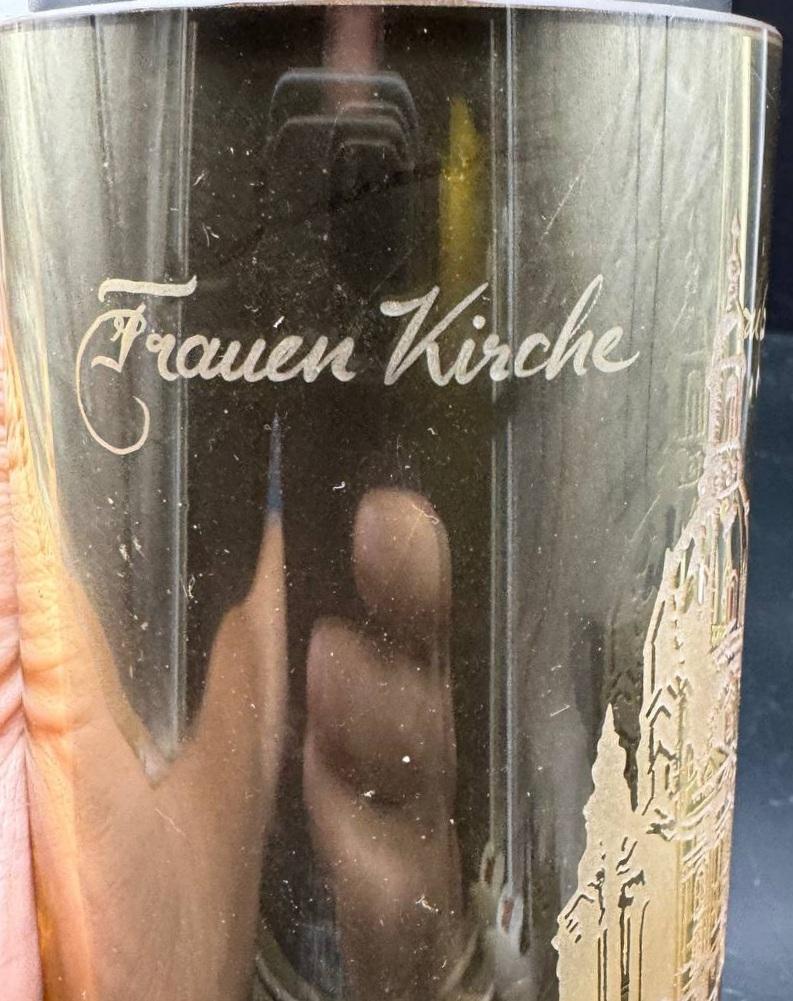
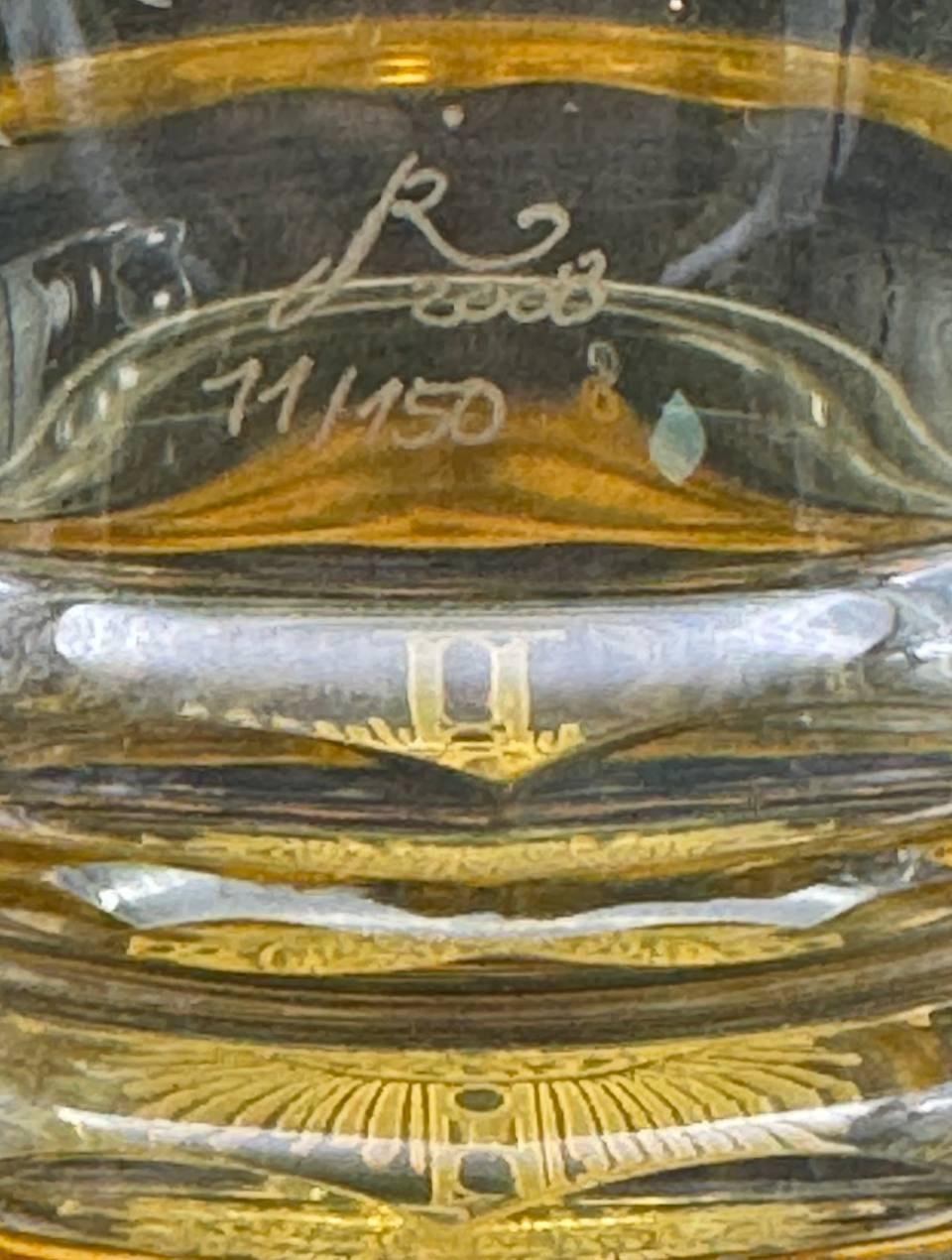
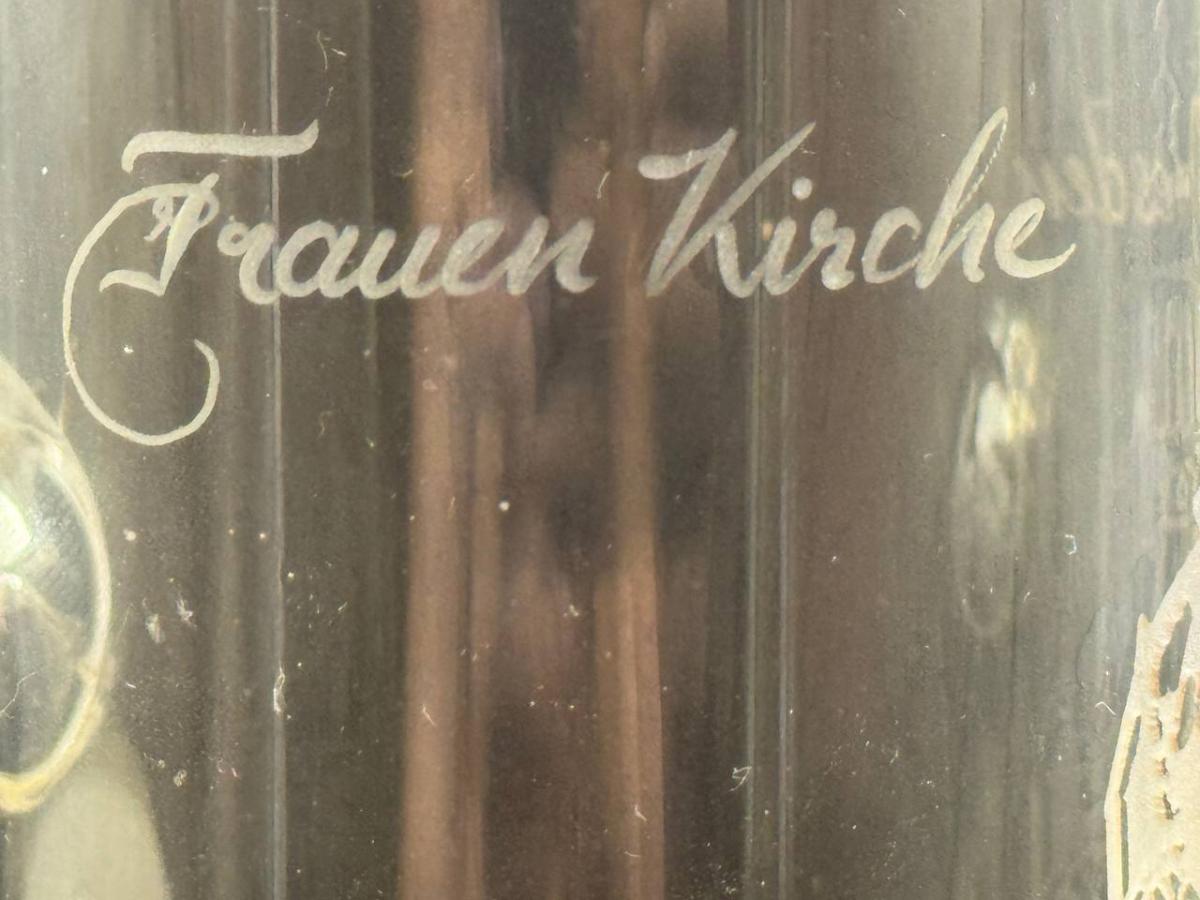
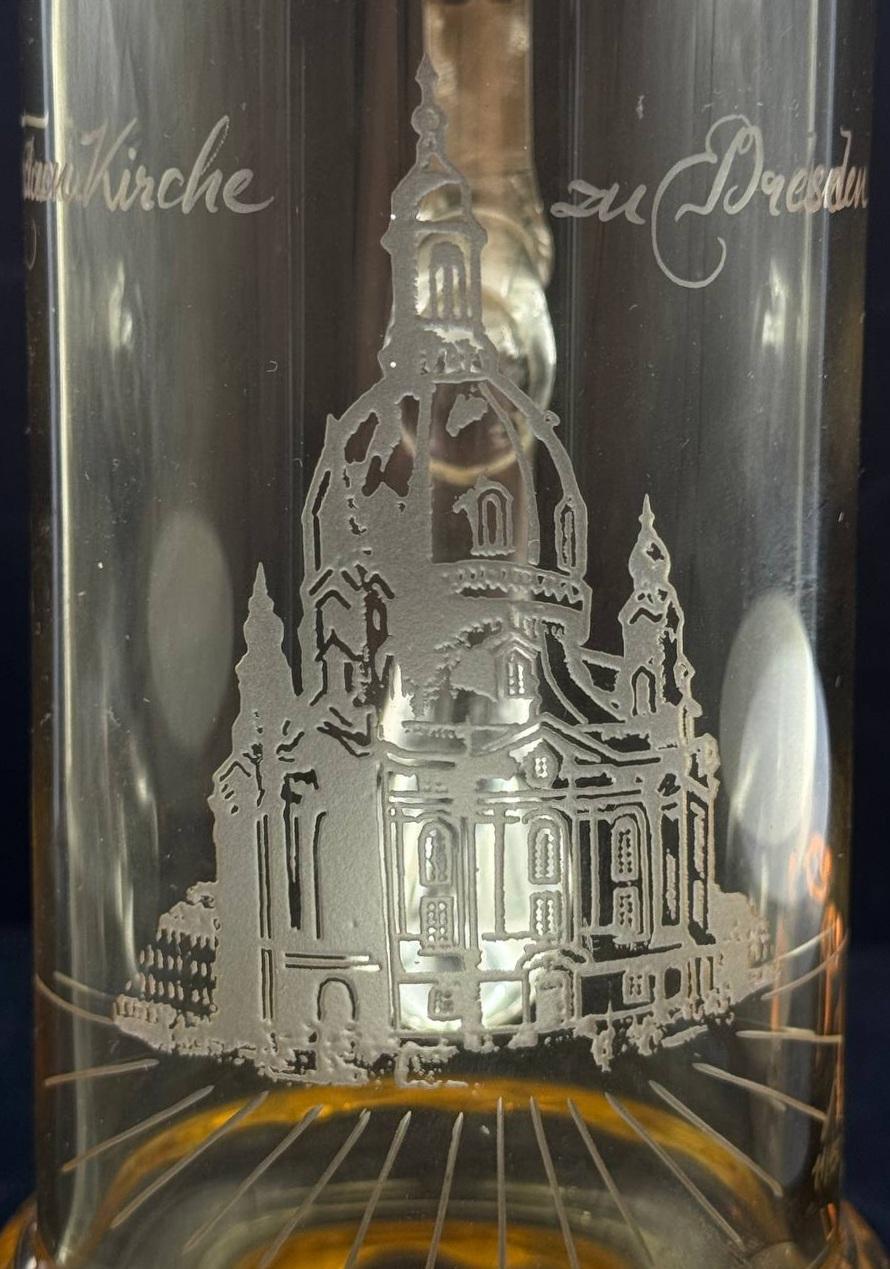
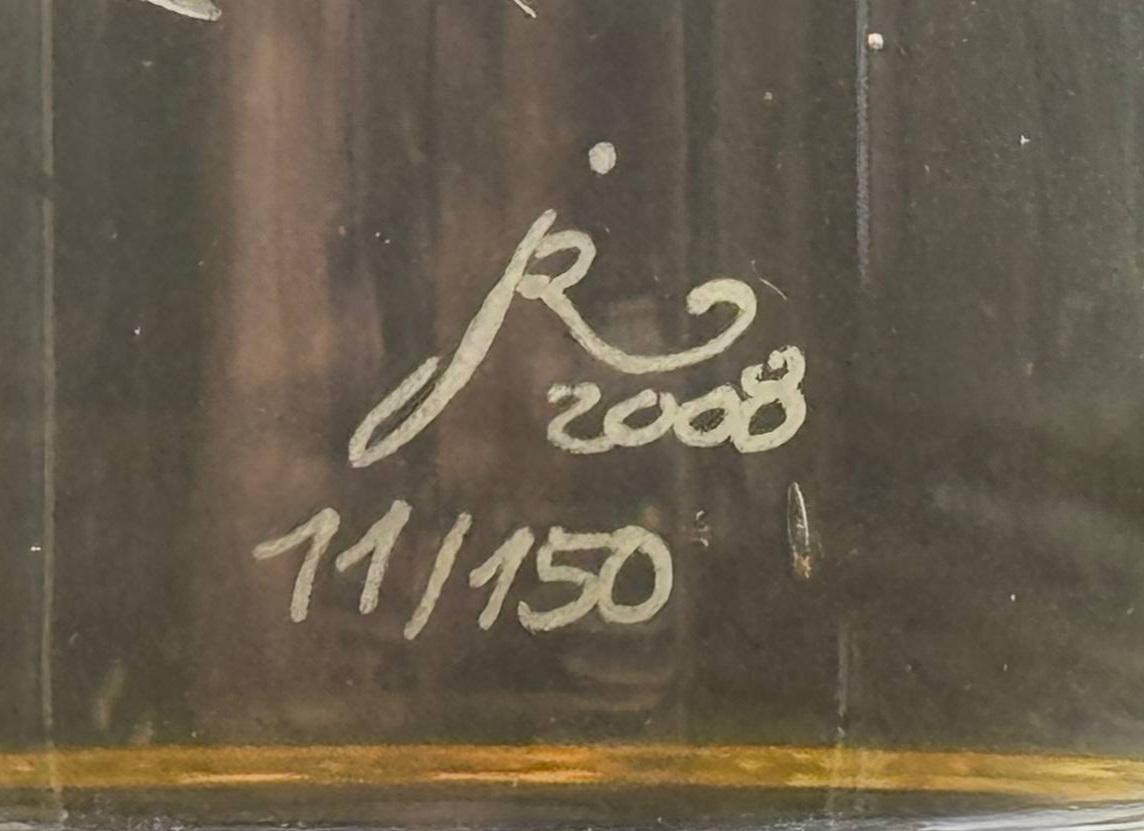
The central decoration of the mug is a view of the stone facade of the historic building of the Dresden Frauenkirche. To the left of this drawing, the phrase "Frauen Kirche" is engraved on the glass surface of the mug. The literal translation from German means "Women's Church". In a religious sense, it means "The Church of the Mother of God." To the right of the main drawing, you can see the inscription "zu Dresden". Translated from German - "in Dresden". On the same side, but closer to the bottom of the mug, you can see an engraved composition of the monogram in the form of the letter "R", accompanied by the letter "c" turned upside down. Below is the number "2000", and below it is the fraction "11/150". Let's try to figure this out.
The letters "R" and, lying down, "c" are the signature of the engraver who applied the decoration to the mug. Unfortunately, it was not possible to find out the name of this master. Moreover, there is reason to believe that the artist may have intended to put a version of his signature, which he has never publicly used anywhere else. There is also an explanation for this.
The number "2000" is the year of the official presentation this is beer mug.
Moreover, by that time, the year 2000 had become largely symbolic for the Dresden Frauenkirche itself. The fraction "11/150" means that this mug became the 11th in a limited edition of 150 copies.
The Dresden Frauenkirche was built in the period 1726-1743 according to the design of the local Saxon architect Georg Behr (1666-1738) by order and at the expense of the Dresden city community. The uniqueness and uniqueness of the project lay in the fact that the massive dome of the cathedral was made of stone blocks. In those years, this was not the case in the German lands due to the lack of technology and materials for the type of cast concrete used in Italy. Nevertheless, representatives of the Dresden aristocratic, military, merchant and craft nobility of the first half of the XVIII century decided not to save money on the main object of the city. They were personally supported in this by the authoritative Elector of Saxony, Augustus II the Strong (1670-1733), who forbade them to abandon the option with a stone dome. Years passed, epochs changed. As a result, by the beginning of the 20th century, the Dresden Frauenkirche had transformed from an object of religious worship into a symbol of the city, which was recognized worldwide as one of the architectural masterpieces of Western European civilization.
At the end of World War II, on February 13-14, 1945, Dresden was subjected to a devastating series of bombings by British and American aircraft. Frauenkirchen was completely destroyed, turning into a pile of stone rubble.
After the war, Dresden ended up in the GDR, which became part of the socialist camp of the USSR. The communist ideology of the USSR, to put it mildly, did not provide for the restoration of religious sites. With this in mind, the pro-communist leadership of the GDR decided to preserve the ruins of the Dresden Frauenkirche as a memorial, reminding new generations of Germans of the senselessness of the Anglo-American bombing of Dresden's cultural heritage in February 1945, when the outcome of the war was already a foregone conclusion.
On November 9, 1989, the Berlin Wall fell, marking the end of the Cold War and becoming a symbol of the collapse of the socialist bloc in Eastern Europe.
Immediately after that, the world-famous German trumpeter, conductor, and one of the outstanding musical figures of the GDR, Ludwig Guttler (born June 13, 1943), prepared a manifesto that went down in history under the title "The Call from Dresden." Ludwig Guttler chose February 13, 1990, as the date of publication of this document, a tragic date for his native Dresden. The 45th anniversary of the start of the devastating bombing of Dresden.
In his "Appeal from Dresden", musician Guttler and a group of like—minded people called on the British and American public to restore the Frauenkirche, the main symbol of old Dresden, which lay in ruins for decades as a monument to the victims of the war. Until then, the official position of the GDR was to preserve the ruins as a warning against war. Guttler's "call" suggested restoring the church as a symbol of reconciliation and the Christian faith. Guttler became chairman of the Society for the Promotion of Church Restoration. Thanks to his international reputation and perseverance, it was possible to raise a significant part of the funds through private donations from around the world. Restoration began in 1994 and was completed in 2005. For Ludwig Guttler, this project became a life's work, combining his musical art and civic position in an effort to heal the wounds of history.
Ludwig Guttler's enthusiasm was supported. Donors appeared. There was a need to create a special socio-financial "institute".
On June 28, 1994, the Frauenkirche Dresden Foundation (German: Stiftung Frauenkirche Dresden) was established, founded by the Evangelical Lutheran State Church of Saxony, the Free State of Saxony (German: Freistaat Sachsen) and the municipality of Dresden, the administrative center of the federal state of Saxony. Maestro Ludwig Guttler was included in the board of trustees of this foundation. The foundation received the official status of a fundraiser, builder and subsequent owner of the restored Frauenkirche.
The renovation cost approximately EUR182.6 million, of which more than EUR100 million was raised through donations.
On the part of the foundation's management, various actions and award ceremonies were held to honor and socially encourage donors with the presentation of inexpensive but symbolic gifts. During the period of Frauenkirche's restoration from 1993 to 2005, the year 2000 turned out to be the most significant. We have three reasons at once. The first reason is the 55th anniversary of the senseless bombing of the city, which led to the destruction of the Frauekirche. The second is 10 years since the publication of the "Call from Dresden". The third is the change of centuries and millennia. Moreover, by 2000, restoration work was already so active that even the most extreme skeptics believed in the resurrection of the Dresden Frauenkirche.
At the personal initiative of Maestro Ludwig Guttler, the foundation agreed to accept a limited edition of commemorative beer mugs as a charitable gift in order to award them to the most distinguished individuals. The mugs were ordered in 1999 to be presented on a memorable day in 2000.
This is due to the lack of attributes on this mug inherent in the item made for sale.
There is only an indication of the anniversary year 2000, a note about the individual number and an autograph of an "anonymous" artist who wished to refrain from self-promotion in this situation.
The presence of all these circumstances indicates the exceptional rarity of this mug.
View the collection of Paulo Vik Falcon

Comments (0)
Log in to add a comment.