


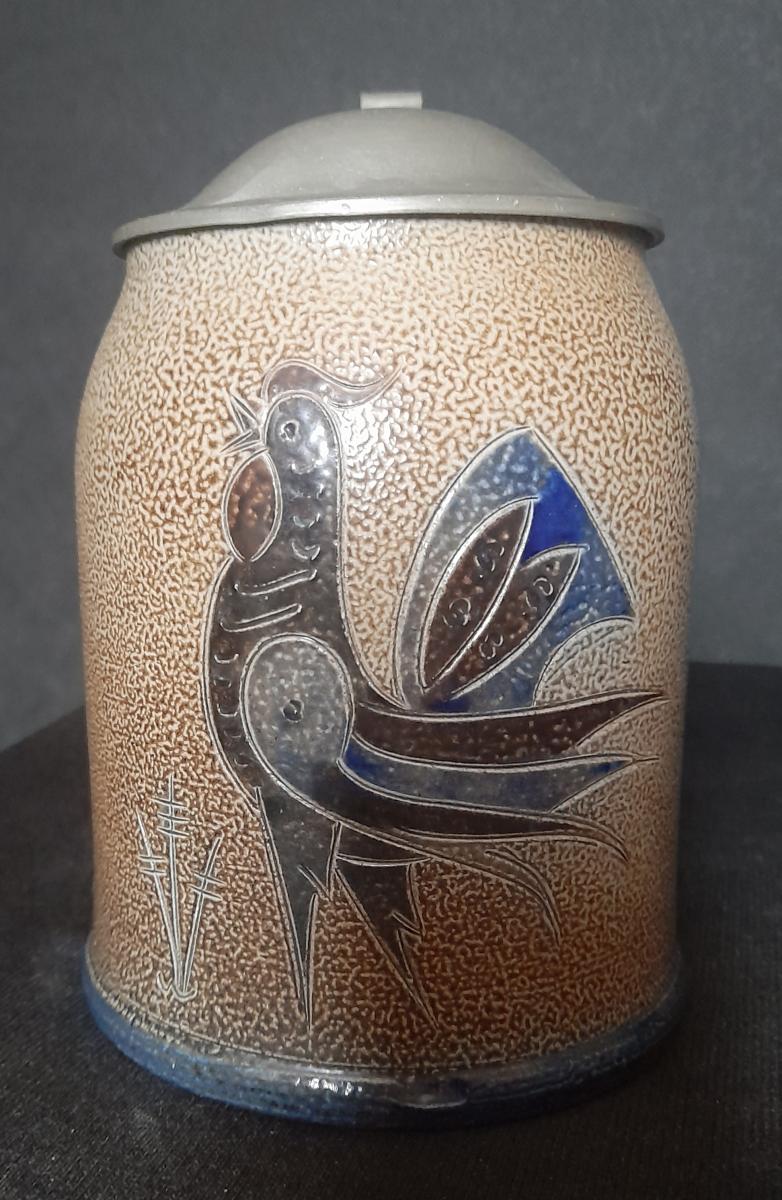
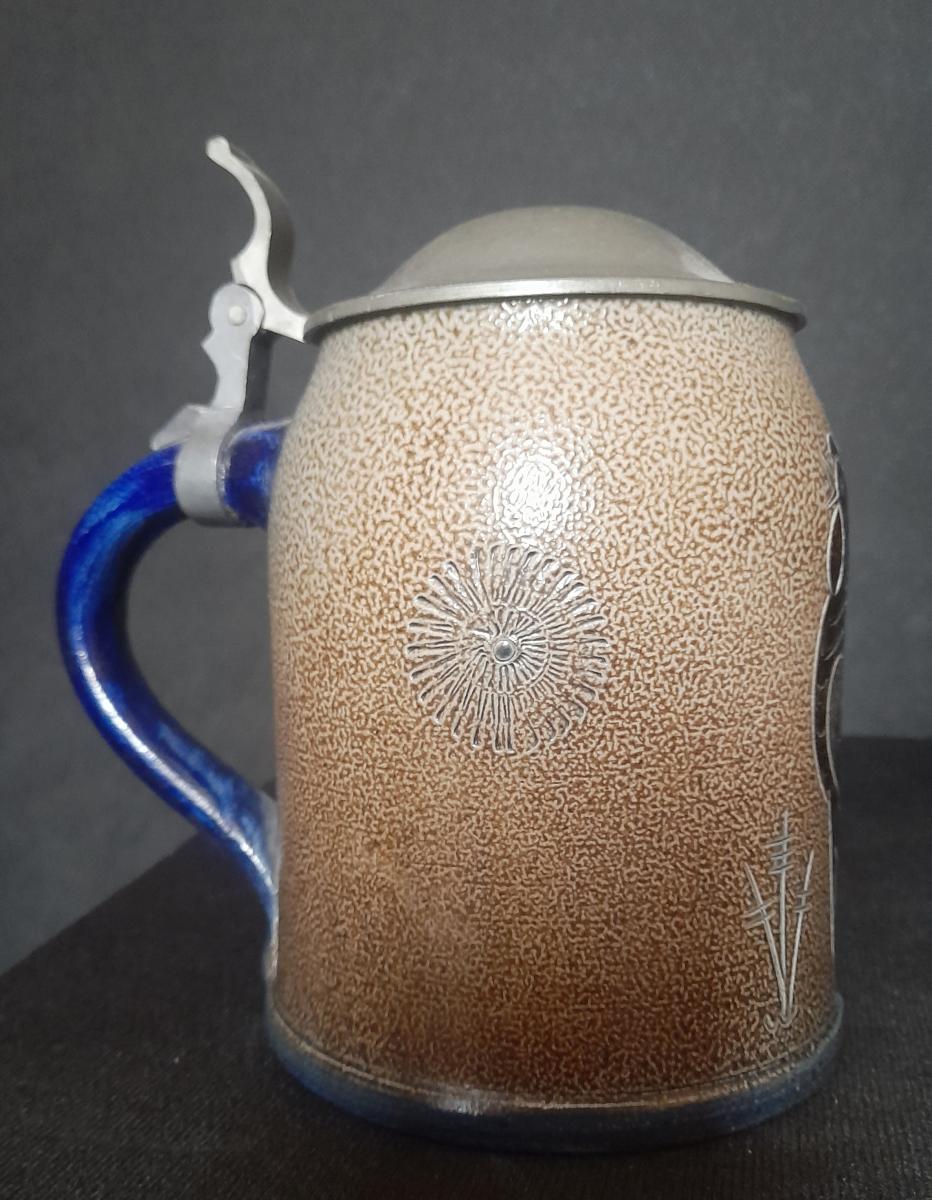
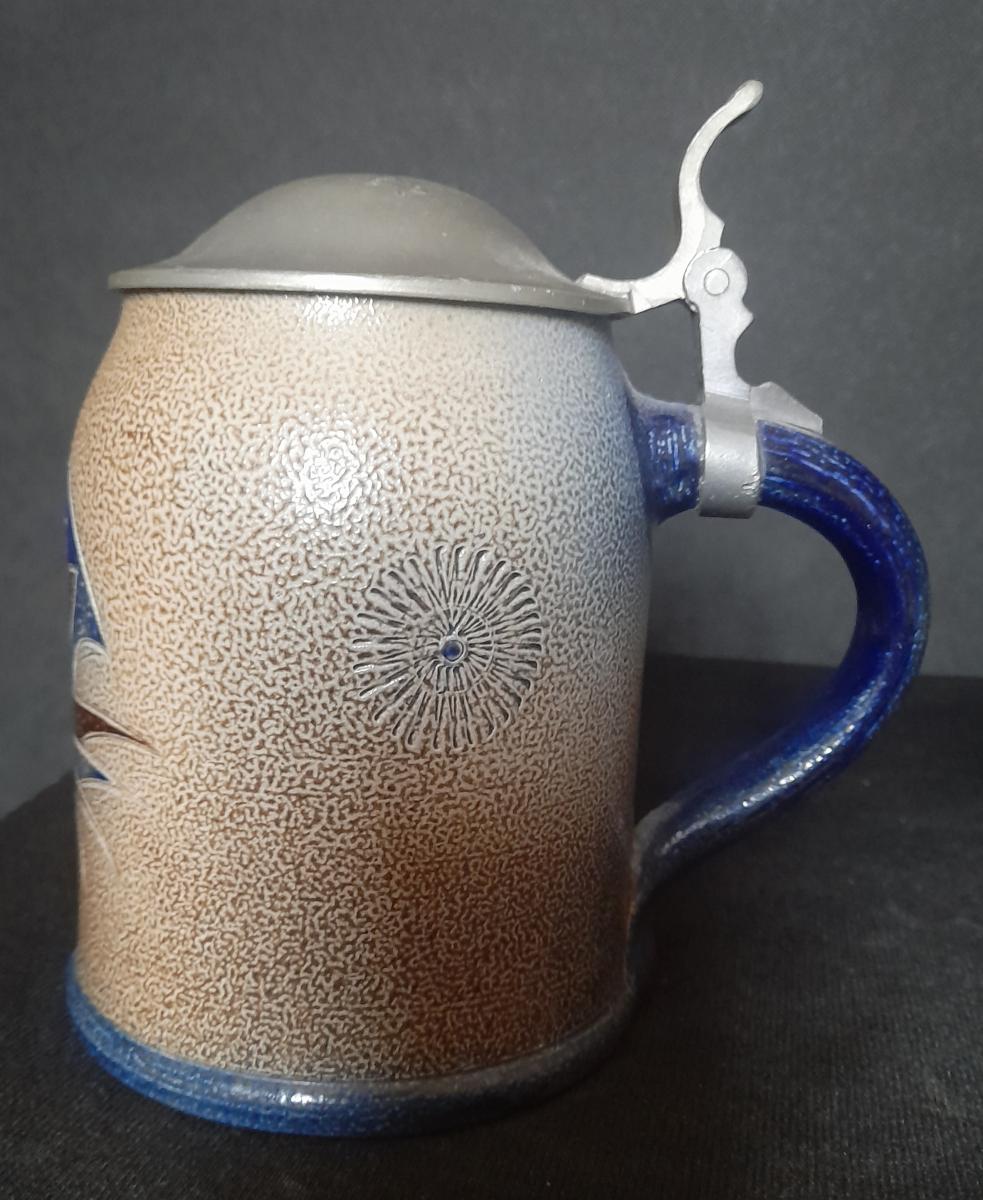
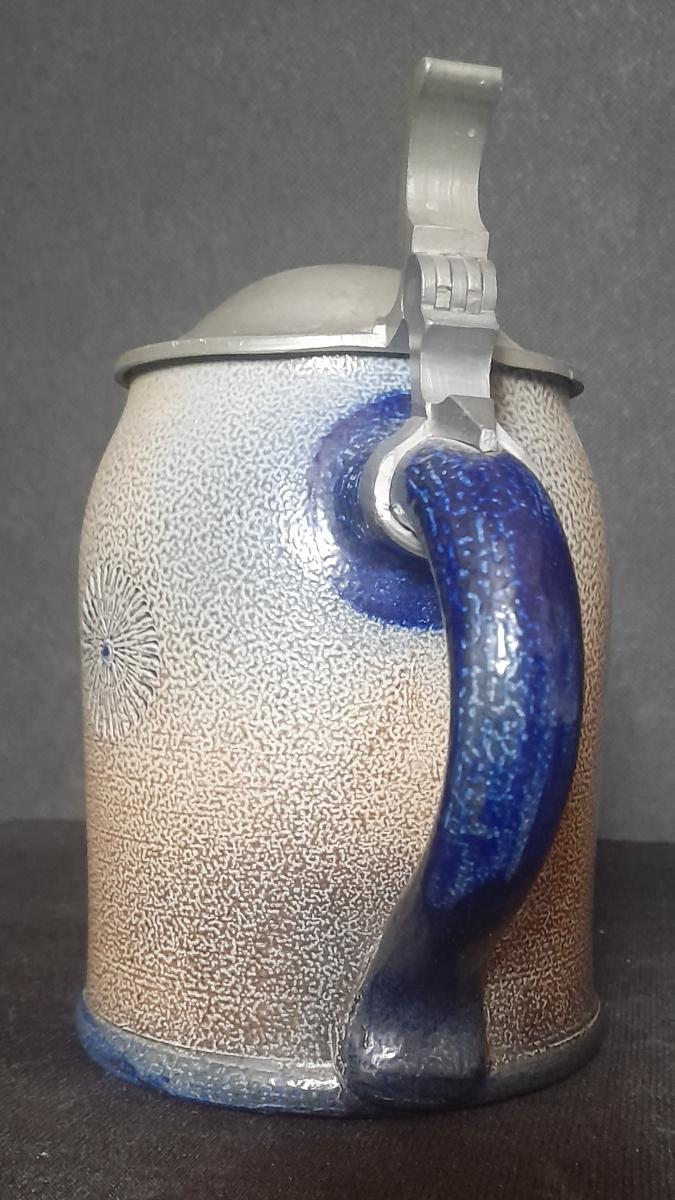
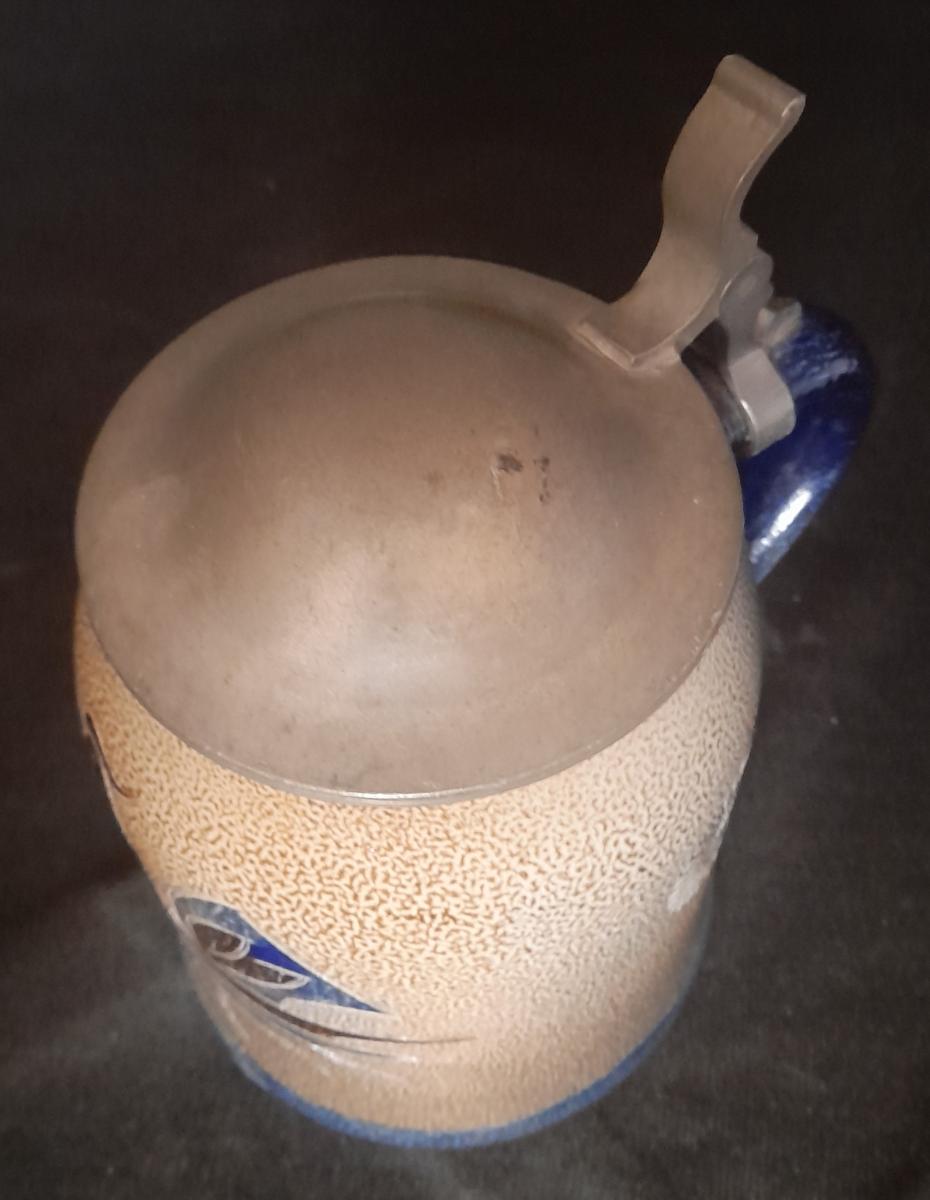
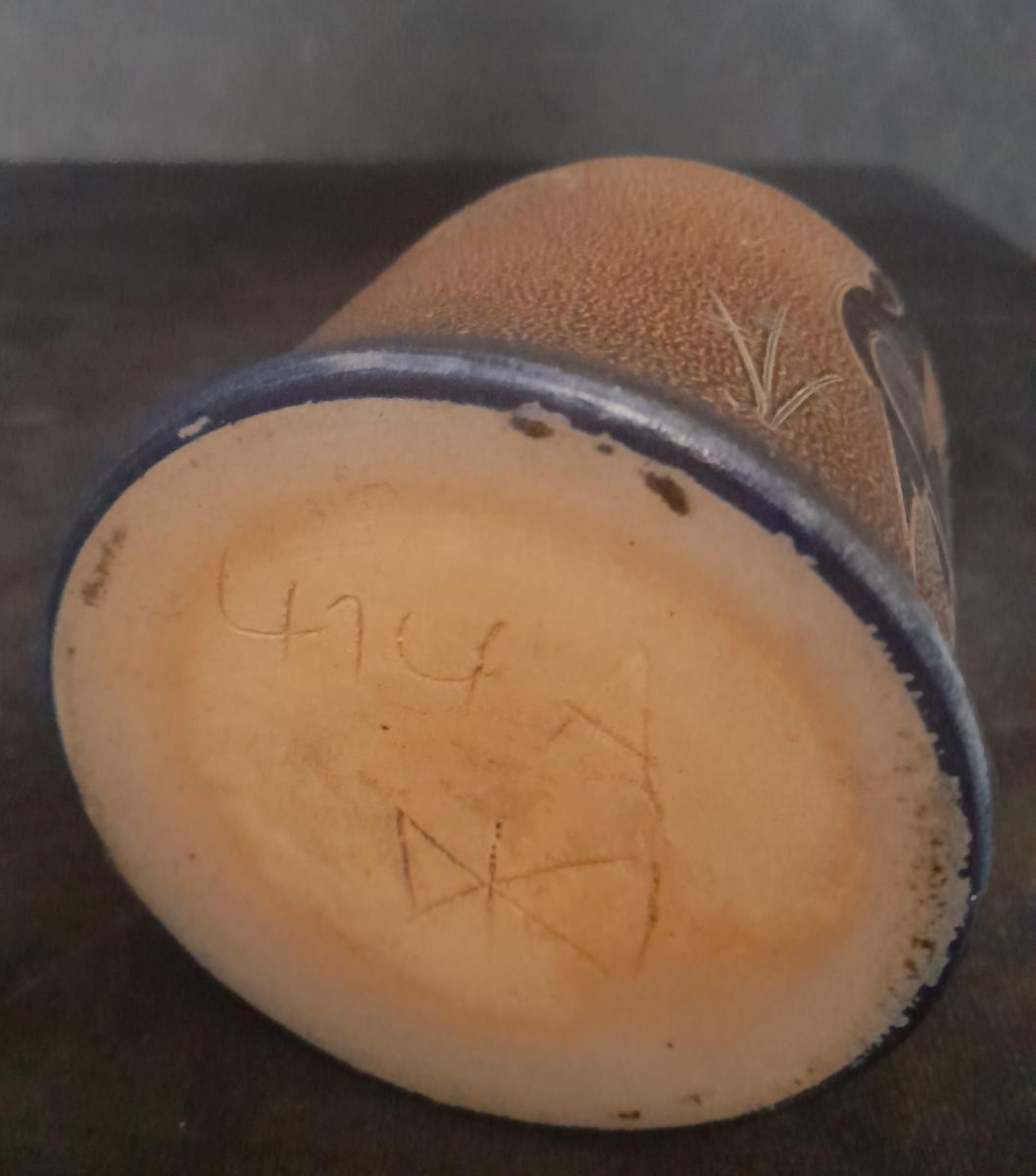
The mug was designed by Wim Mühlendyck. His art ceramics factory was located in the town of Herrenzhausen (Rhineland-Palatinate).
Wim Mühlendyck was born in the city of Porz-Cologne on March 1, 1905. In 1926-1927, he studied at the State Ceramic School. From 1931 to the 1970s, he ran his own workshop and pottery production.
Wim Mühlendyck collaborated with Elfrida Balzar-Kopp. He died in Herrenzhausen on April 10, 1986. Source of information on the link: [link]
Mulendick was distinguished by his independent approach to work away from large
manufactories. Even today, pottery is still practiced in the premises of the pottery yard.
The Mulendick Pottery Yard is located at 39 Lindenstrasse in the Grenzhausen district. It is located just outside the city, on the same street and just a few minutes walk from the westerwald Ceramics Museum. The pottery yard is an elongated rectangular structure. The hipped roof is lowered to the ground floor. The furnace shop is directly adjacent to the building on the left side. This small building also has a hipped roof.
Wim Mühlendyk was born in Cologne-Porz in 1905 in the family of a pastor. After trying different courses of study, he came to pottery.
The artist Kurt Derkum (1904-1969), who was his friend, recognized Mulendick's talent for drawing.
Mulendick's passion for craft led him to a Cologne workshop in 1925. From 1926, he continued his studies at the technical school of Herrenzhausen. At the same time, he occupied an old ceramicist's workshop on 12 Bergstrasse in Hera, which was an independent community until 1936. Mühlendyk's inspiration
came from the products of the German Workers' Union. This association released the exhibition "Form without ornament" in 1924. Mühlendyk followed the German werkbund and left the unpainted gray surface of his salt-glazed vessels. The functionality of the products was more important to him than their artistic design. Nevertheless, Mulendik was looking for decoration options. Instead of the typical blue coloring of porcelain stoneware, he practiced his own carved patterns. He later described it as the “real birth hour" of his pottery workshop.
In 1927-1930, Mulendik studied at the Higher Pedagogical School of Cologne as a business teacher. He
kept and used his workshop in Herrenzhausen when there was time for it. In 1930, Mühlendyk returned to Her and, together with ceramist Elfriede Balzar-Kopp, founded a company called BaKo, Westerwälder keramisches Workschaften GmbH. They independently mastered the techniques of drawing and knitting, and also created drawings of animals and flowers. This method was no longer taught at the college. A year after the company was founded, it became insolvent.
In 1931, the case reached bankruptcy. In the same year, Mulendick married an experienced kindergarten teacher, Elizabeth "Bita" Bever (1908-2004), a distant relative of Friedrich Engels.
Mulendik's rich father-in-law, who was a great friend of the pottery yard, helped him get out of debt.
Since 1933, crafts have experienced a new upsurge under the Nazi regime. Thus, Mulendick was able to hire his first student, Rudy Stahl (1918-1987). The students were an integral part of Mulendick's pottery workshop, and since then he has always been actively involved in their training. After Stahl, he took his sister Ruth (1913-2004) and Ernst Stauber (1921-2003) with him to teach.
Finding a suitable piece of land for a pottery farm was difficult at first, until he found a plot. Lindenstrasse 39. However, in 1936 the Mühlendijk pottery yard in Grenzhausen was completed. The pottery yard had a kiln shed with a pitcher oven attached to the main building. There was a living space above the workshop.
It became a dream come true for Wim Mulendyk. Subsequently, he expanded his activities to include building ceramics. Because of his
Mulendik paid special attention to Christian symbolism in the design of his ceramics, which was clearly religious. This helped him to get orders for the construction of churches and public buildings, which, in turn, increased his fame. He also received the Honorary Prize of the Paris World's Fair in 1937 and the gold medal of the Berlin Craft Exhibition in 1939. The pottery yard during the Second World War.
Wim Mulendick and almost all of his staff were drafted into the war before 1940. His wife
and three children also left the Pottery Yard to seek protection from relatives in northeastern Germany. The productivity
of the pottery farm almost stopped, as Mulendik could only return home from the front during his vacation. At the end of the war, in 1945, the family had to flee from northeast Germany from the Russian troops.
They returned to the Pottery Yard. It was damaged, but habitable. Although the living conditions were very limited, as supplies such as firewood were looted.
A new beginning.
Bita Mulendik immediately resumed operations with the return of its former workforce. Wim Mulendyk was held captive in Scotland from 1944 to 1946. Influenced by his experiences during the war, he stayed in England to study for a lay priest, and worked there as a pastoral mentor for a year. In 1948, he returned to the pottery workshop. When Mulendyk started working again, he took his son Johannes (1933-2013), who was 14 years old at the time, as an apprentice. Johannsen left his father's pottery yard after passing the apprenticeship exam in 1951. In 1958, Johannes returned.
By that time, he was married and had children. At first, Johannes worked independently in pottery and began to pursue his own craft. Two years later, he was reunited with his father. Outwardly, they looked like a "pottery yard –
Wim W. Johannes Mulendick". The main staff members at that time were Walter Bluth (1929-2014), Doris Heller and Birgit Em (dates of life unknown).
Achievements and awards.
In the 1960s, the company was very successful. The pottery yard exhibited at exhibitions in Frankfurt and Leipzig and received
lots of orders. In 1965, Mühlendyk received the honorary prize of the "German Ceramic Society" DKG. In 1967, the workshop installed one of the first gas-heated salt furnaces in Herrenzhausen. Mulendick was initially skeptical about the new technique, as he lacked the character of the glaze obtained by firing using wood. However, the new gas-fired furnace produced fewer defective goods, and the shine of the vessels was popular with customers. Thus, the company experienced a boom and
by the mid-1960s had 15 employees and students.
In 1976, Wim Mulendick and Rudy Stahl received the Federal Cross of Merit together. This award was given for his innovations in westerwald ceramics and his work as a teacher, on the Board of Directors of the State College for Pottery and examination boards. This event was celebrated at Grenzau Castle. In 1985, the westerwald Ceramics Museum hosted the exhibition "Wim Mühlendyk and the Students", dedicated to the 80th anniversary of Wim Mühlendyk. In addition to Rudy Stahl, many members of the Mühlendik family were among the students represented, such as
his wife Bita, his son Johannes, the latter's wife Rosvita, Mühlendik's daughter Katarina (born in 1942) and her husband Theo Dietz (born in 1938).
The death and legacy of Wim Mulendick.
On April 10, 1986, Wim Mulendyk died from the effects of a stroke. At first, Theo Dietz headed the pottery yard with
the support of Birgit Em, an employee. Meanwhile, Bita Mulendik moved to Koenigswinter. In 1992 Elizabeth Dietz Blazner (born in 1965), the granddaughter of Wim Mühlendyk and the daughter of Theo Dietz, became the owner of the pottery yard. She and her family moved to a pottery farm. Thus, she also took over a staff of six, which still included Birgit Em, Doris Heller and Walter Bluth. Elizabeth brought new forms and motifs to pottery, which were particularly well received at the Frankfurt Fair.
Since 1999, Elizabeth's husband Stefan Blasner (born in 1966)
began experimenting with more environmentally friendly salt glaze methods. Instead of table salt, Stefan used caustic soda, which is better suited to dosage, and at the same time released fewer side gases.
He received the Innovation Award in 2001 for this development The Federal Fund for Environmental Protection.
In the early 2000s, sales deteriorated further and the workshop began to be used only as auxiliary equipment. The number of staff decreased until 2003, usually due to retirement. Elizabeth Dietz-Blasner and
Stefan Blasner opened up new horizons. Elizabeth thought about creating a workshop and rented it out.
Parts of the premises were transferred to the artists Daniele Polz (born 1967) and Dirk Rothe (dates of life unknown). Claudia
Henkel (born in 1966) joined later. She still works in the pottery yard. Source of information on the links:
www.deutscher-werkbund.de
www.daniela-polz.de
www.dirkrothe.com
www.porzellan-claudia-henkel.de
www.keramik-sammler.de
View the collection of Paulo Vik Falcon

Comments (0)
Log in to add a comment.