




Bautzen coat of arms
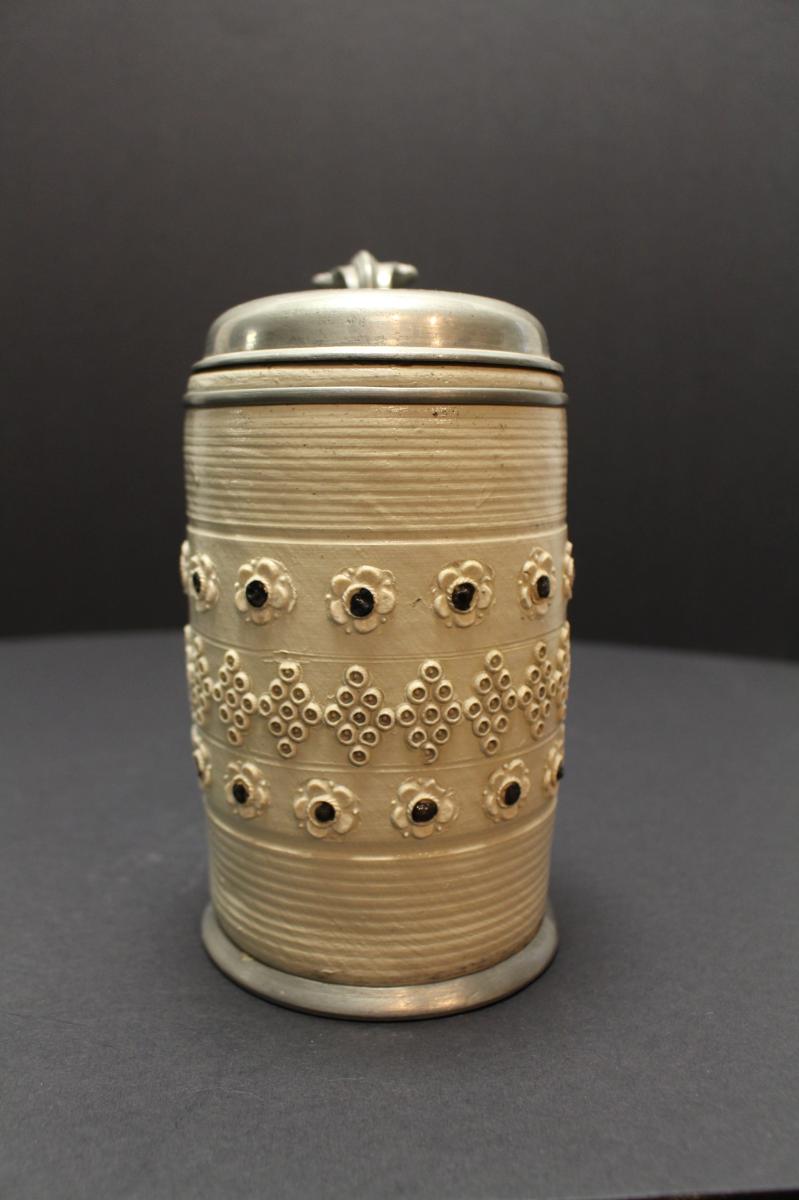
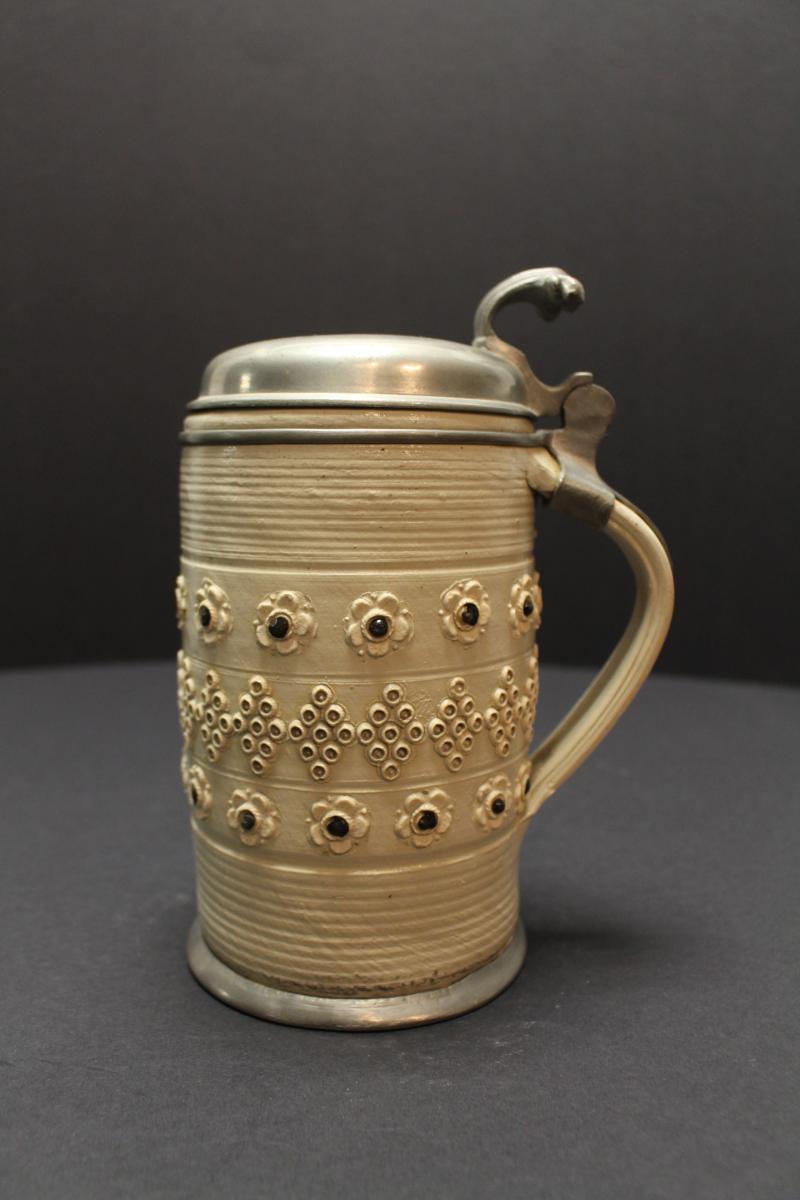
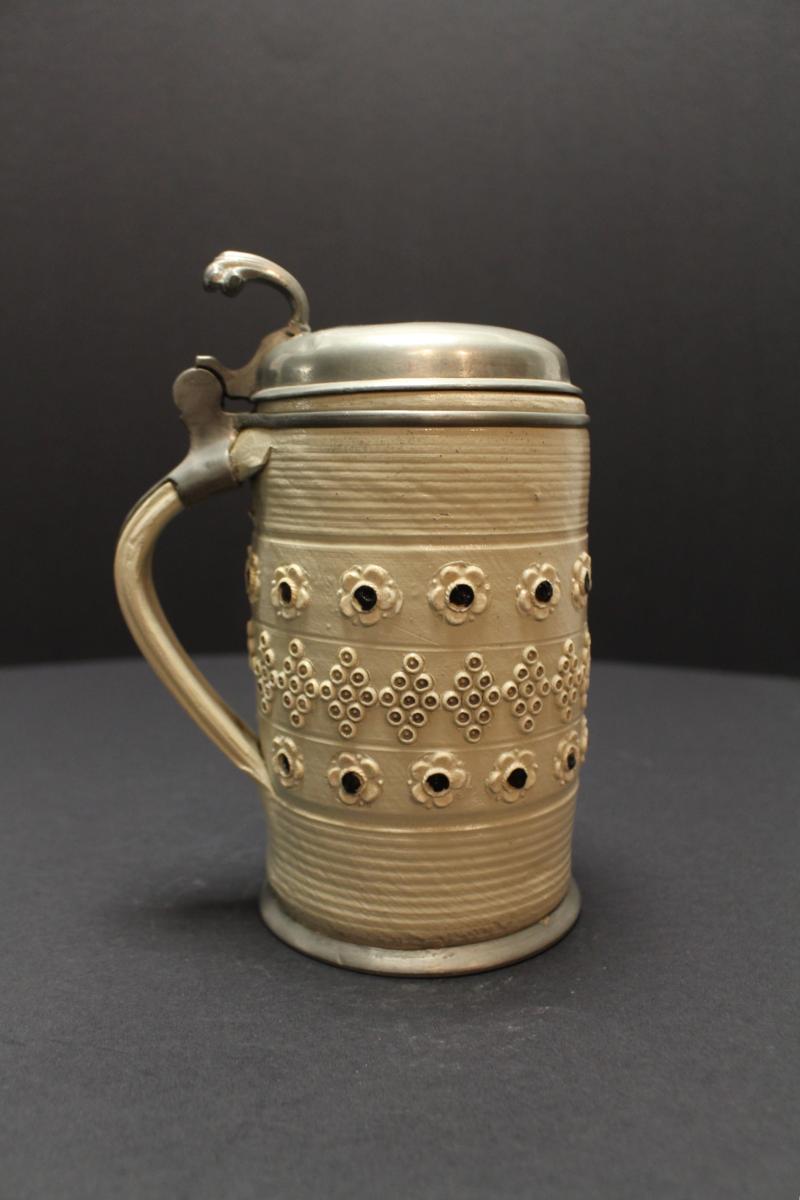
Cylindrical shaped stein
Shallow grooves decorate the top and bottom sections. Applied relief of flowers and circles with brown glaze accents decorate the center section.
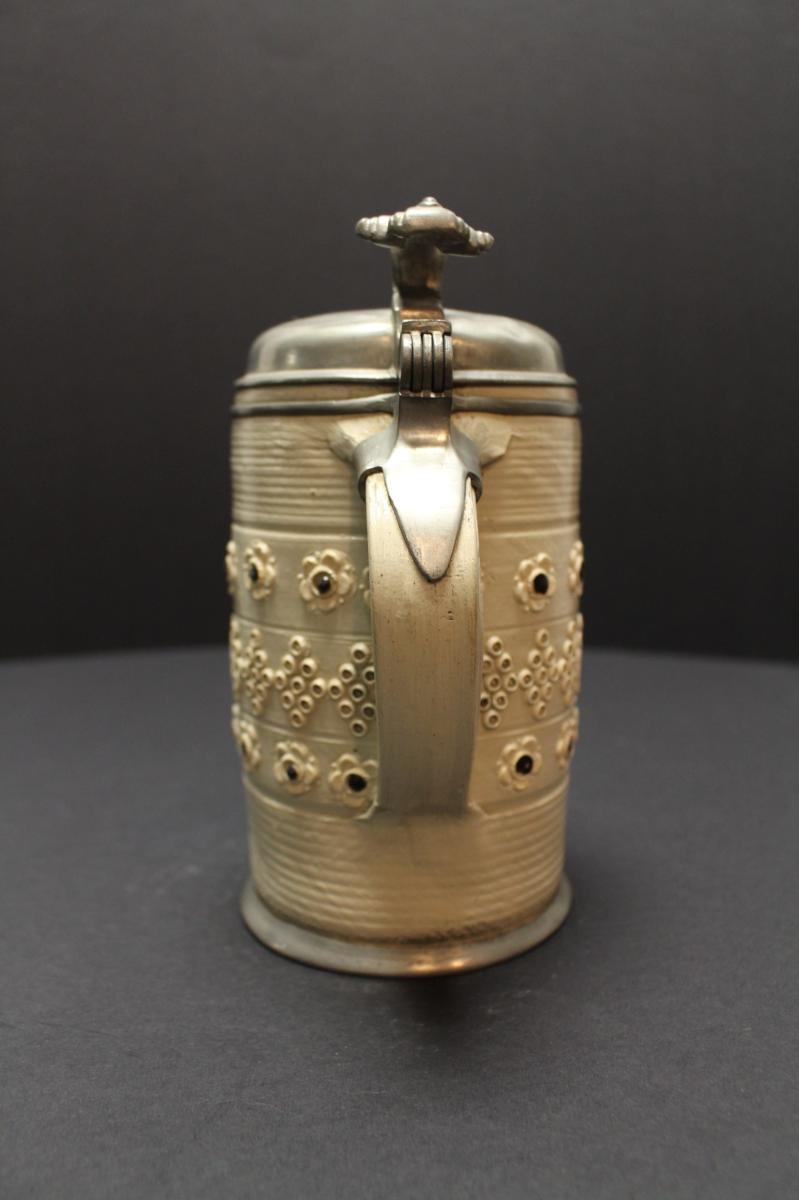
A thin, wide, belt-shaped handle (Altenburg identifier) is attached.
Holds approximately .8 Liter.
Altenburg is located in eastern Thuringia, not far from the border of Saxony.
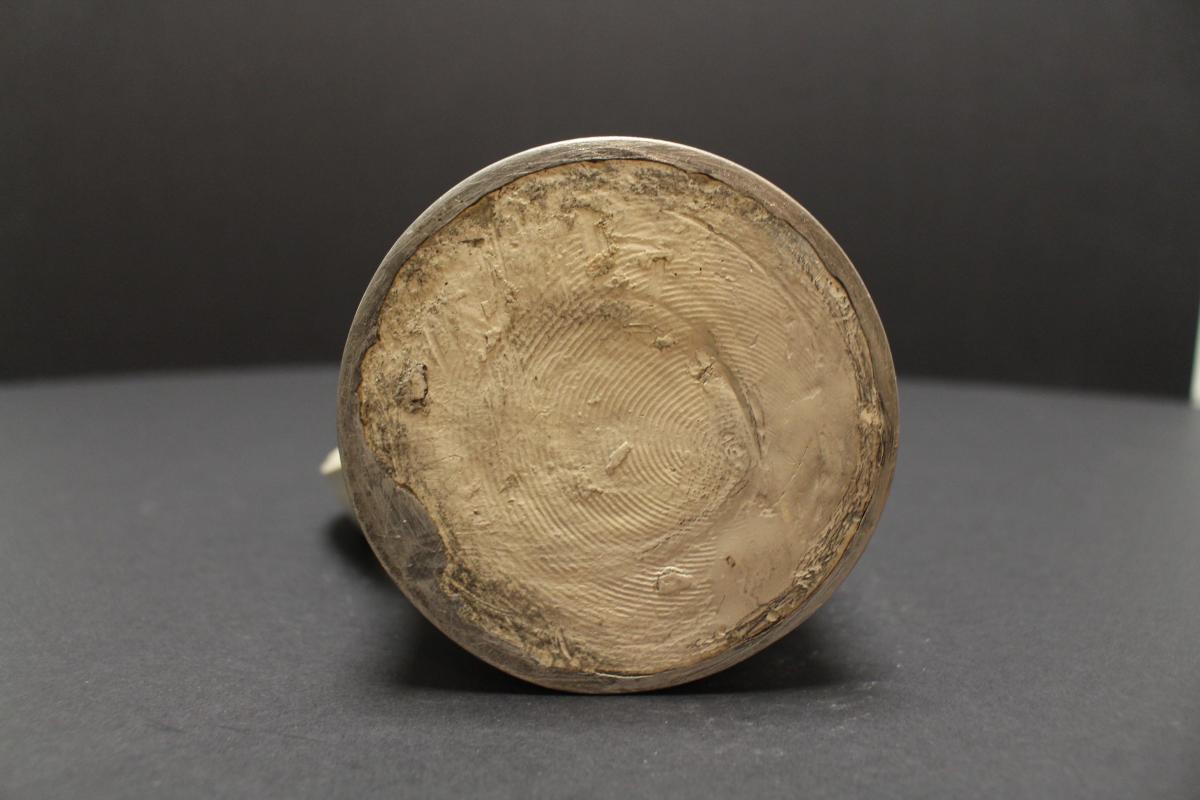
Around 1730, potters in Altenburg began making production changes resulting in time and cost savings, possibly in response to competition from less expensive faience products. The sections of grooves (top and bottom) were widened and the central section was made smaller. The deep grooves around the body were mostly eliminated, as were the pewter rings. Potters had achieved the ability to vitrify their clay pieces at lower temperatures, which required less fuel for the kilns. Due to the lower firing temperatures, the clay for the handles could now be tempered with a finer grain sand to achieve the proper strength without cracking; this resulted in no longer needing to apply pewter handle straps. Pewter foot rings were applied instead of full bases.
From 1745 to 1780, the Altenburg potters produced reduction fired vessels. Reduction firing (reduced oxygen in the kiln) resulted in vessels that were light gray or almost white. From about 1750 to 1765, small circles were very popular as a decoration. The circles were applied, forming a lacework edge, which looks like a slightly shifted diamond band.
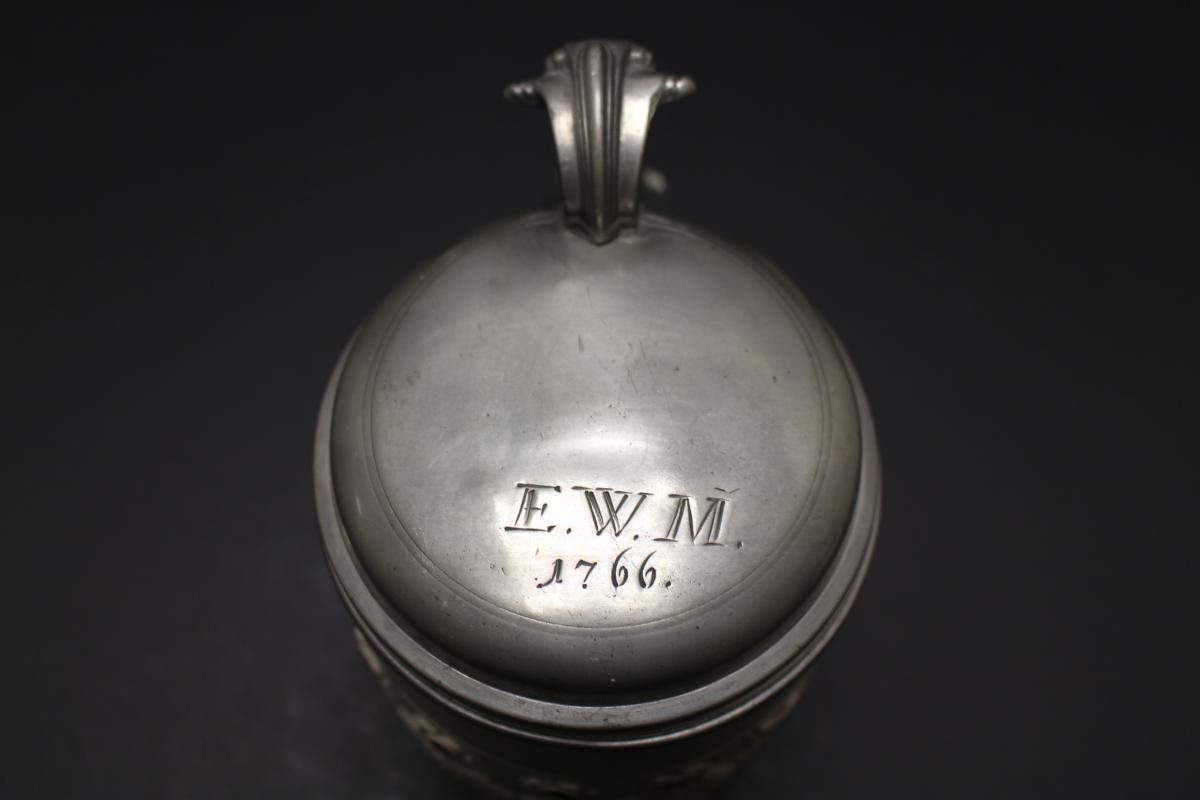
The pewter lid, large closed 5 ring hinge, and thumb lift are appropriate for the time period. Unlike earlier Altenburg vessels, there is only one pewter body ring below the lid and there is only a simple foot ring. The lid is personalized “E.W.M. and dated 1766.
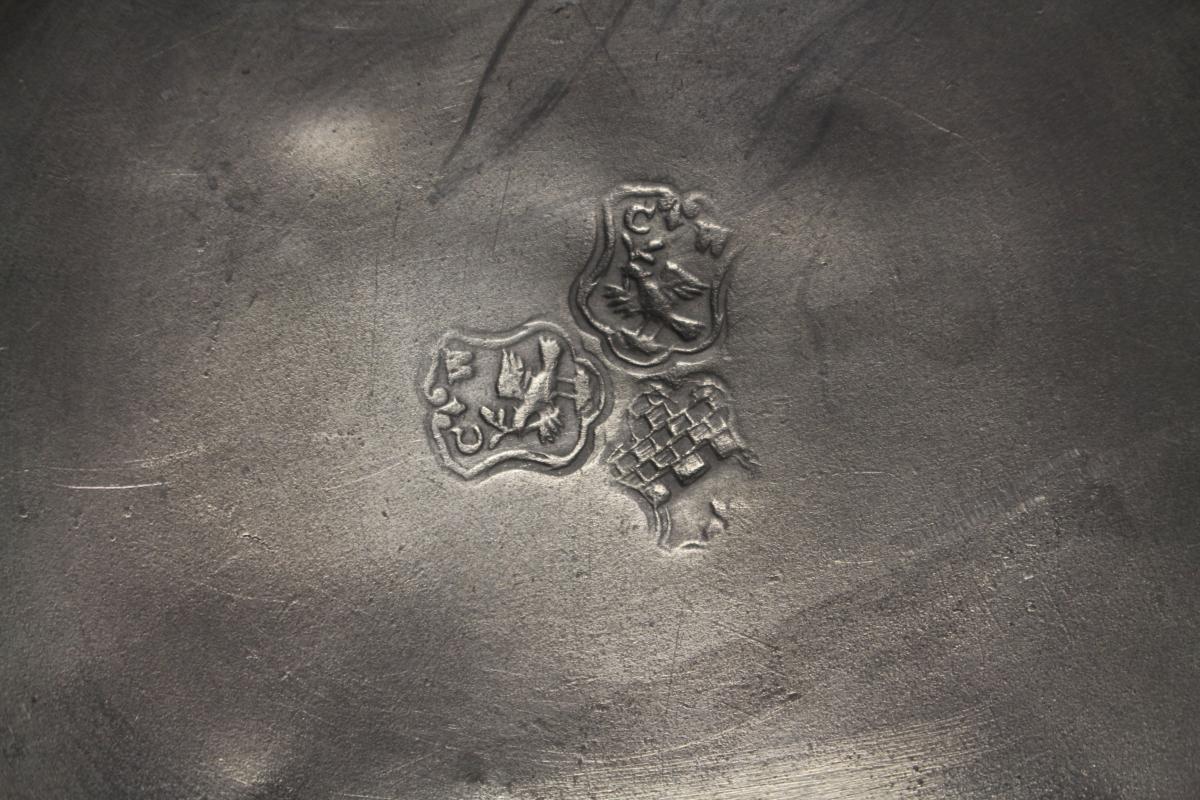
The pewter mark with the initials “CW” and the bird image were identified as belonging to Carl Weigang (Weygang, Weygand), son of the pewterer Johann Weigang in Bautzen. Weigang trained with his father from 1755 to 1759 and he became a master craftsman on June 9, 1766.
The other mark is the shield portion of the coat of arms for the town of Bautzen, which is located in eastern Saxony.
References:
Early Stoneware Steins from the Les Paul Collection by Beatrix Adler, pgs 27 - 67
Die Deutschen Zinngiesser und Ihre Marken, Band I, Sächsische Zinngiesser by Erwin Hintze, pg 29

Kommentare (0)
Einloggen um ein Kommentar ein zu geben.