


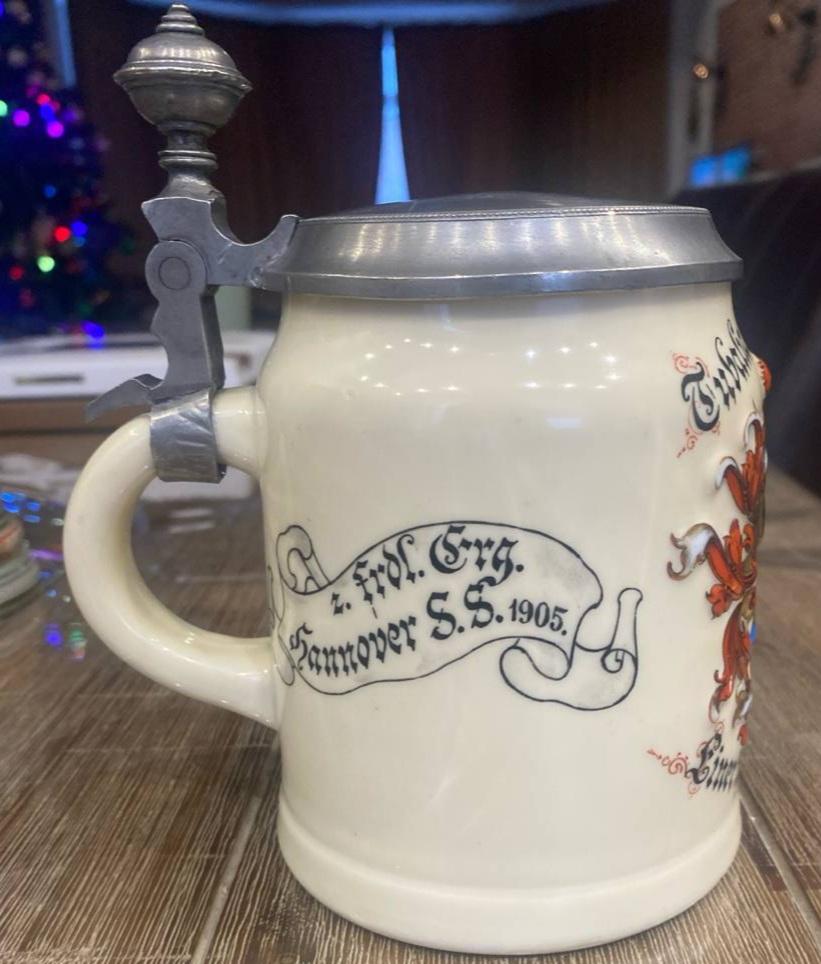
Beer mug of the student fraternity "Tübalia".
A video clip about this mug can be viewed at the link:
[Link]
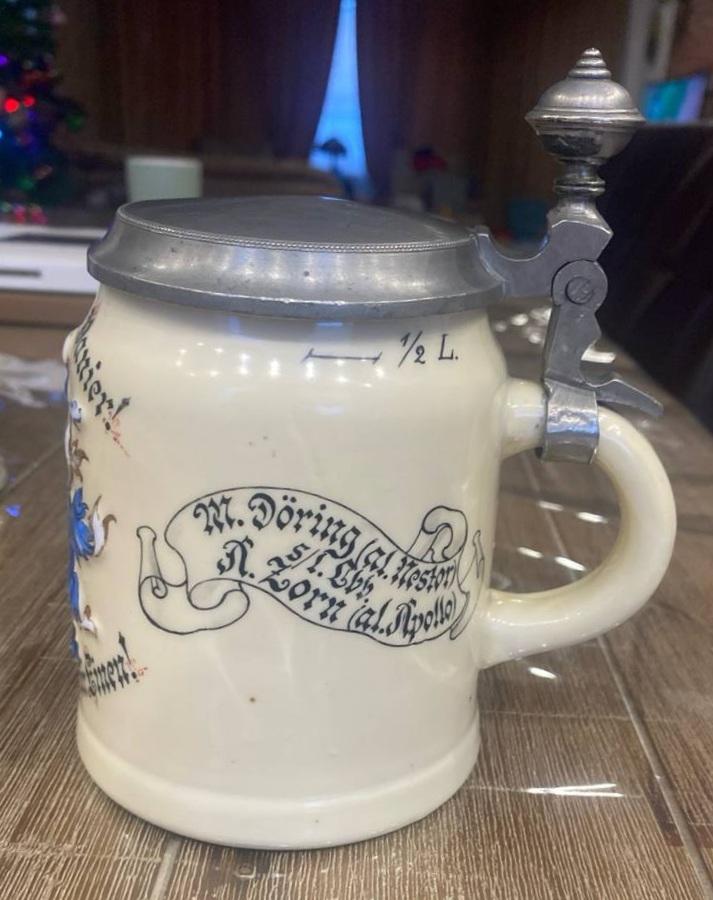
This antique beer mug was made in 1905 and painted according to a special individual order in the amount of only two pieces. The names of the two first owners of two such mugs are applied from the left side of the handle of the cup.
First, let's analyze the content of the inscriptions on the surface of our mug.
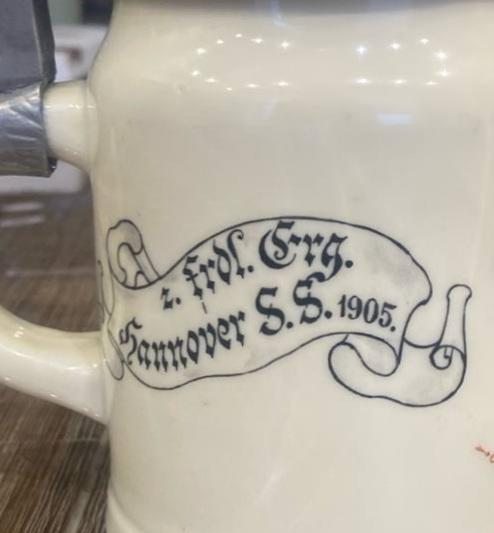
On the surface of the mug to the right of the handle there is an inscription executed in Gothic style: "z. frdl. Erg. Hannover S.S. 1905." Translated from German, it means: "In memory of friendship. Hanover Student Union. The year 1905". This is a semantic translation, not a literal one, since in the original version the phrase was composed using slang abbreviations used by members of student associations, fraternities or unions.
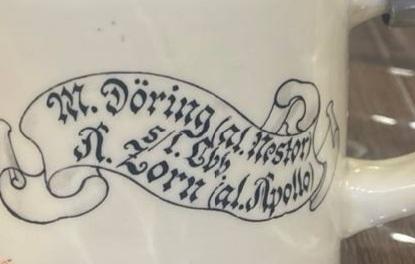
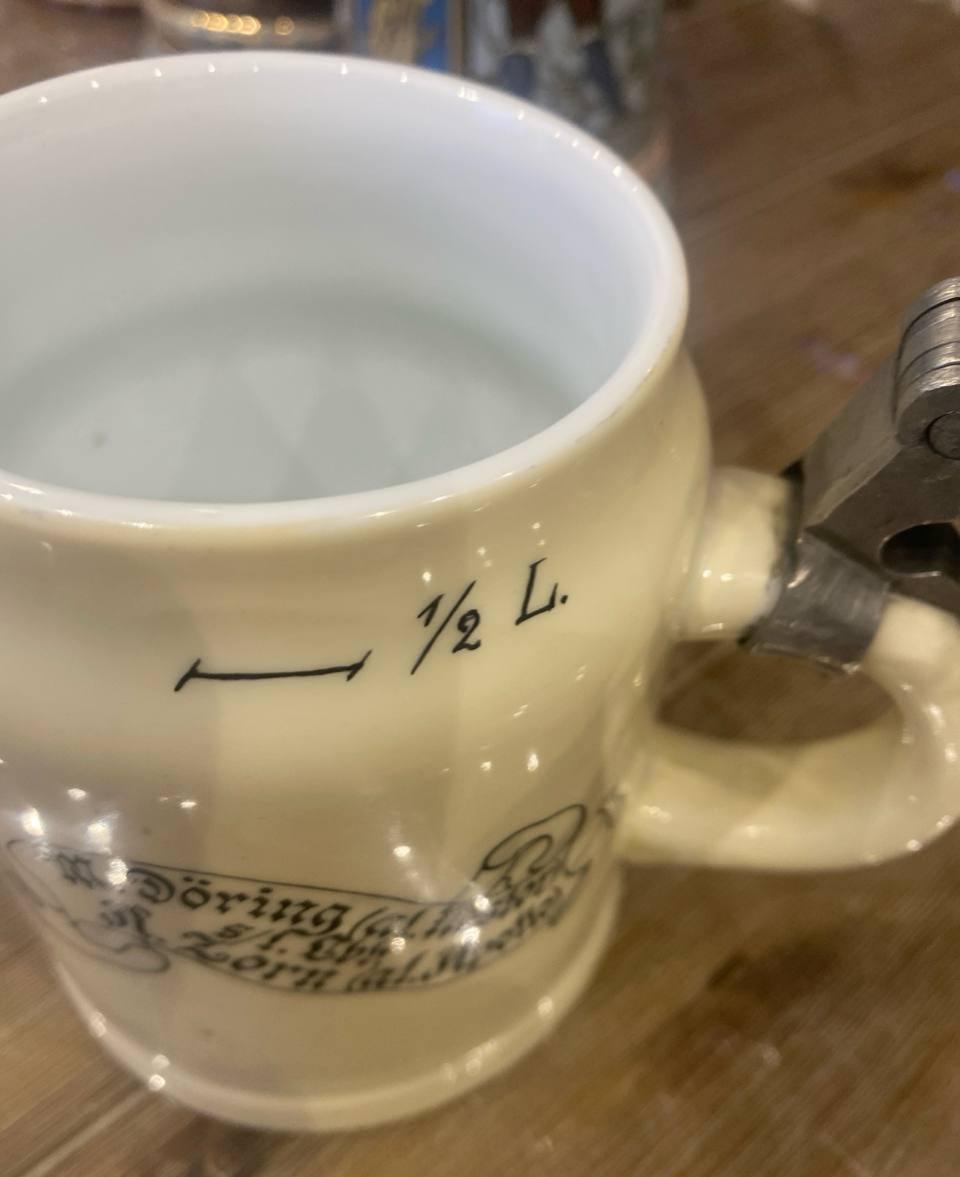
The inscription to the left of the handle also refers to the German student fraternity (Burschenschaft), where "al." means alias (translated as "also known as"). The names M. Döring and A. Zorn are the names of the students, and "Nestor" and "Apollo" are their nicknames. Simply put, the translation is: "M. Döring (known by the nickname Nestor) and A. Zorn (known by the nickname Apollo). This is a common practice in German student corporations, where members receive nicknames, often referring to mythology, literature, or history.
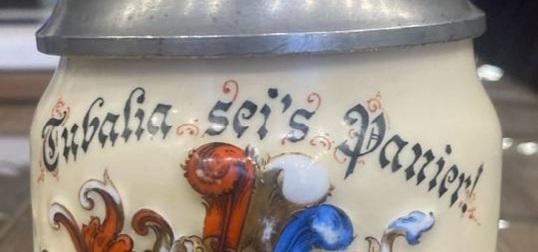
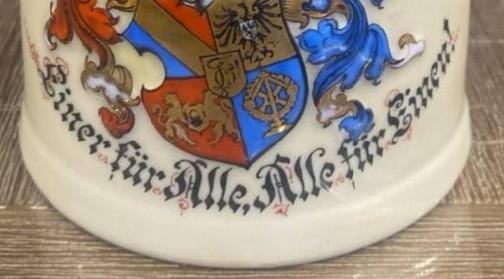
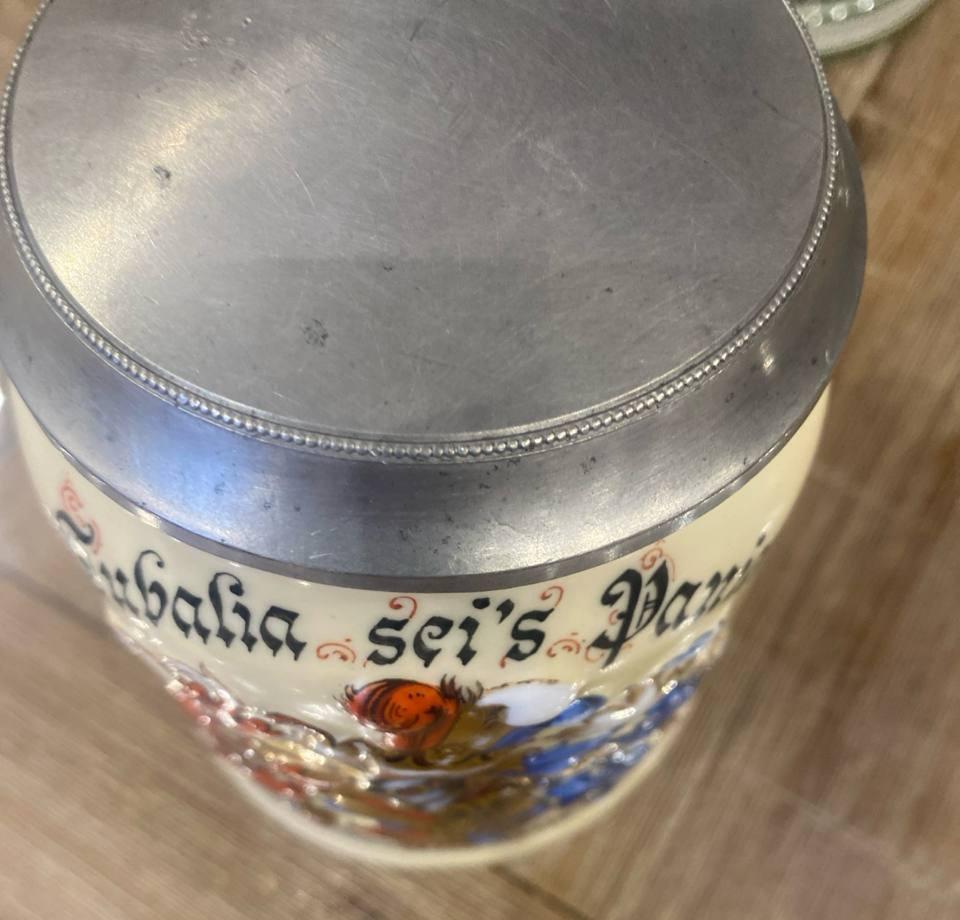
In the central part of the circle we see two inscriptions. The top inscription, "Tubalia Sei's Panier!", is a German phrase and is commonly found on student beer mugs (Studentika Krugs). "Panier" is an outdated German word meaning a banner, a banner or a standard. Tubalia is the name of a specific student association or corporation. The phrase as a whole translates roughly as "Tubalia be our banner!" or "Long live the banner of Tubalia!".
The bottom phrase "Einer für Alle, Alle für Einen!" in German means "One for all, all for one!".
This phrase became a world-famous motto thanks to Alexandre Dumas' novel The Three Musketeers (1844). The Latin equivalent of the phrase, "Unus pro omnibus, omnes pro uno", is the unofficial motto of Switzerland. In student societies, this motto emphasized the camaraderie and mutual support of the group members.
The Tubalia Student Community was established in 1895 at the University of Hanover. By Leibniz. Only men could be members of the Tubalia student fraternity. At the time of the establishment of this student body, the University of Hanover was called the Royal Polytechnic Graduate School, endowed with university status.
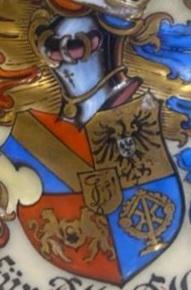
Tubal's student community had a very rare scientific and technical orientation for its time (equipment construction/technological design) with its own specialized library. This factor is reflected in the coat of arms of the Tubalia community. It's a gear wheel on a stand. Tubalia's color scheme is red, golden brown and blue. The symbols of the Tubalia community were painted in these three colors. The design of our mug allows you to see this. The Tubalia Student Society operated until 1975. Further fate is unknown.
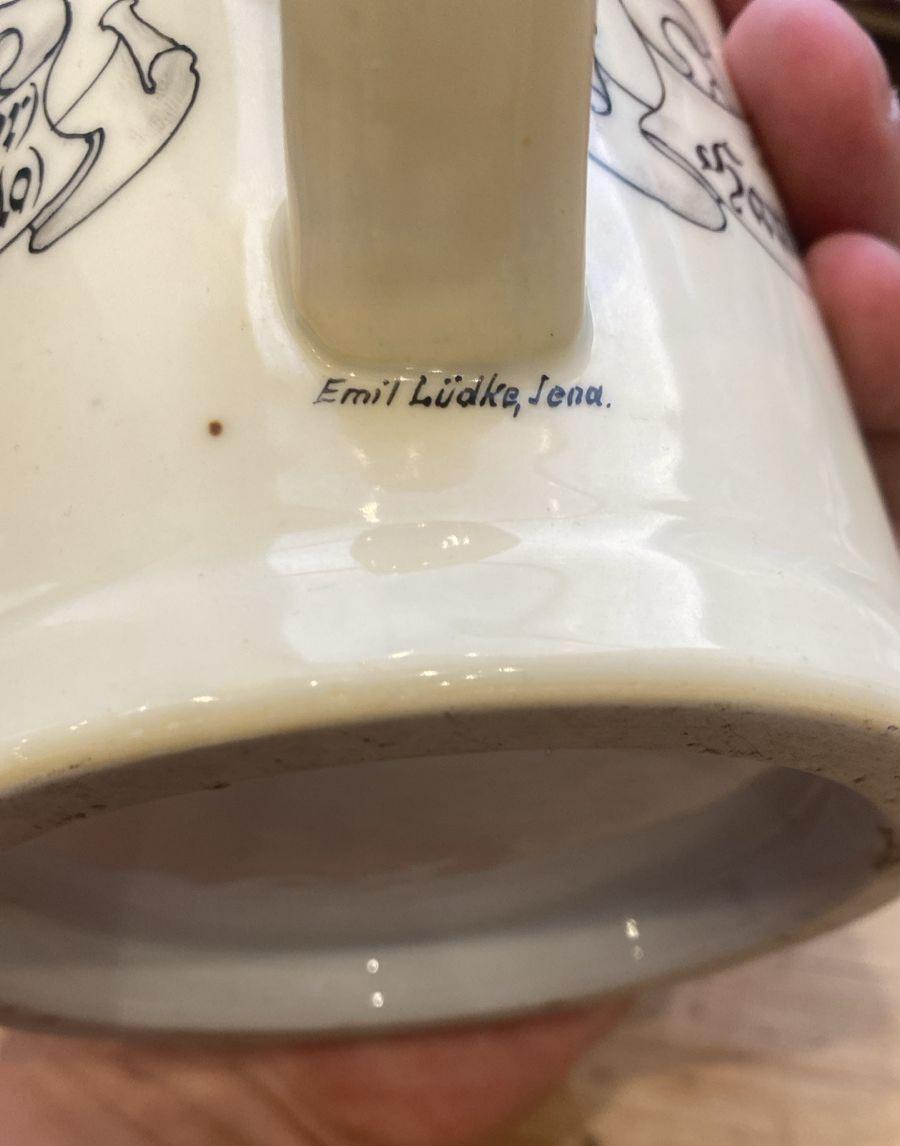
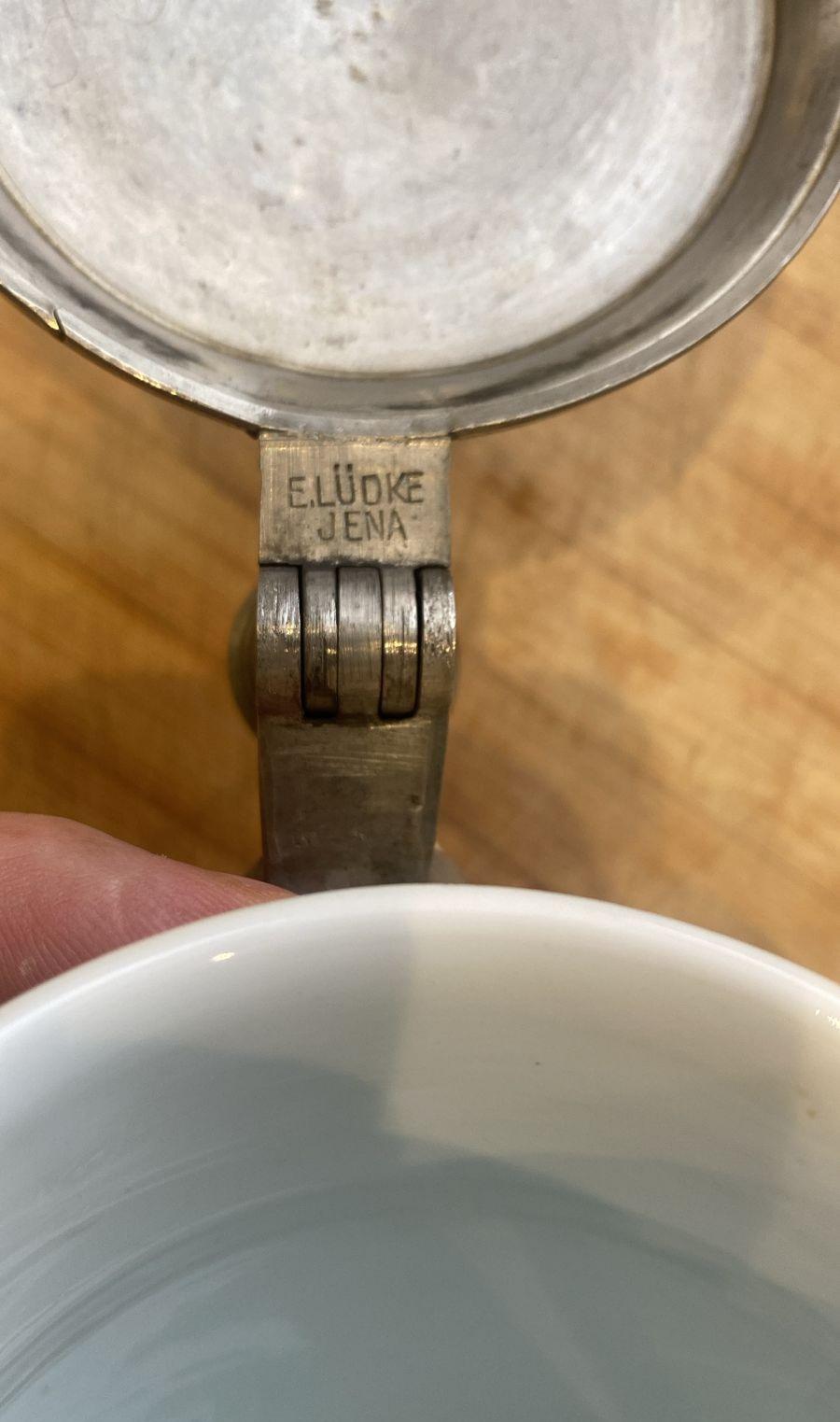
There is an inscription in small print under the handle of the mug: "Emil ludke, Jena". We can see the same inscription in the form of a stamp on the tin lid lifting mechanism. This is evidence that the same person was responsible for painting the mug and creating the tin lid - Emil Ludke from the city of Jena (Thuringia). Jena is a university city in Germany on the Saale River, the second largest city in Thuringia after Erfurt. The art manufactory "Emil Lüdke, G.M.B.H" (until 1890, "Carl Hahn & Sohn") specialized specifically in painting and decorating student circles according to individual orders from members of various student communities.
Between 1888 and 1890, the company was acquired by Emil Ludke. Prior to that, it had belonged to its founder Karl Khan since 1842.
Karl Khan and his son claimed that their company has the status of
"Die grösste Studentenrequisiten-Fabrik Deutschlands" / "The largest producer of student gifts and regalia in Germany". Before the takeover by Emil Ludke, Carl Hahn & Sohn was a supplier to the court of the Grand Duke of Saxe-Weimar and the Duke of Saxe-Altenburg in 1881-1882. The source of this information is located at: [Link]
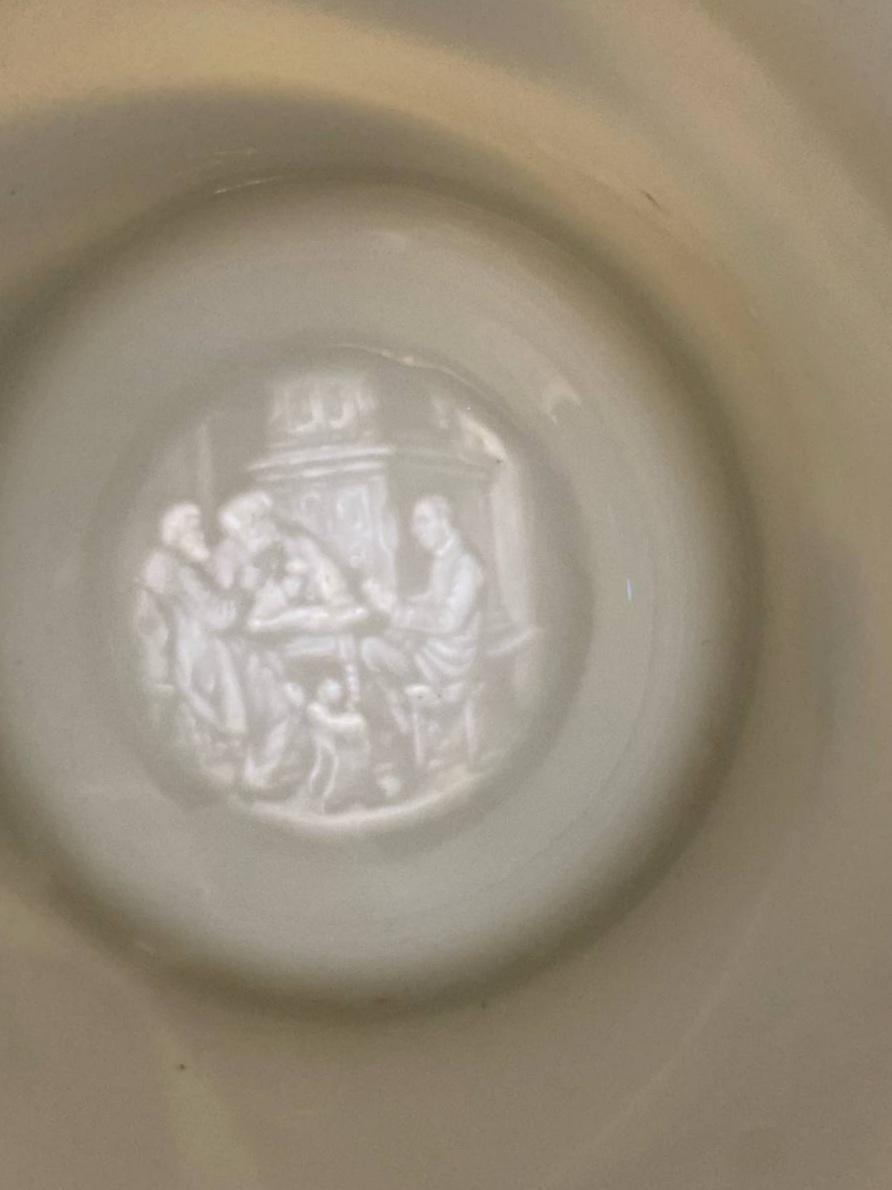
Emil Ludke's innovative solution, which allowed to multiply the legacy of Karl Khan, was the use of porcelain mugs with relief and lithophany for student orders. In our case, the mug has these two artistic advantages.
Zeig alles von Paulo Vik Falcon

Kommentare (0)
Einloggen um ein Kommentar ein zu geben.